
Browse > Home /

| Subcribe via RSS

That’s not the way to do it

June 12th, 2010 | 1 Comment | Posted in Bangladesh, South Asia, governance, politics

Subscribe to ShahidulNews


Share/Bookmark


Bangladesh
Politics reverts to Punch-and-Judy type
Jun 10th 2010 | Dhaka
The ECONOMIST

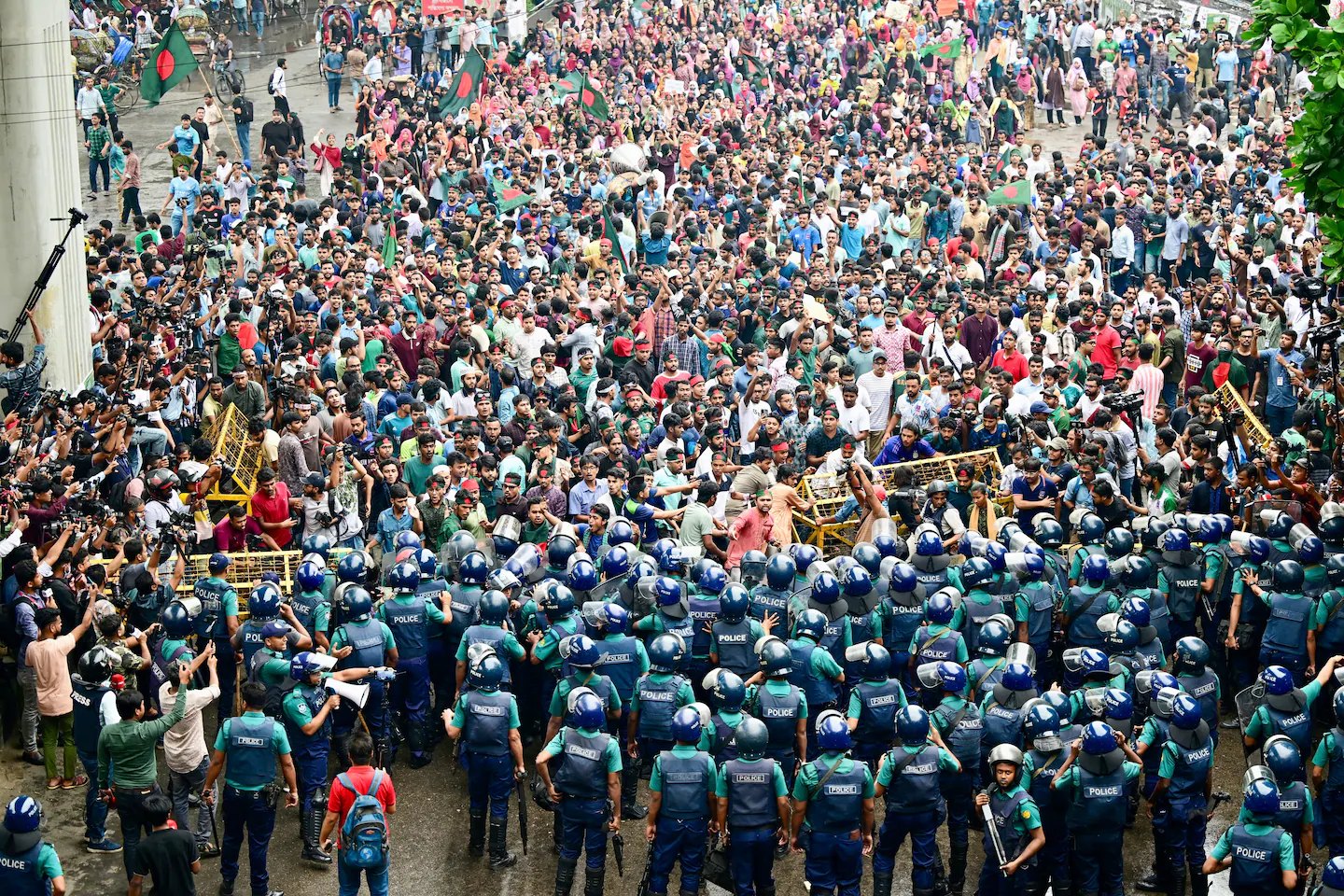
“THE chances of another coup in Bangladesh are close to zero,” says a former general in Bangladesh’s army. That sounds excellent. But the country’s “rival queens”—Sheikh Hasina, the prime minister, and Khaleda Zia, who were both jailed during an anti-corruption drive by an army-backed government in 2007-08—seem to see the soldiers’ docility as an opportunity. The result is that, 18 months after Sheikh Hasina’s Awami League (AL) won a parliamentary election in a landslide, Bangladesh’s politics is back to normal: personal, vindictive and confrontational.

This week Mrs Zia’s opposition Bangladesh Nationalist Party (BNP) extended its boycott of parliament. She has called a nationwide hartal (protest strike) for June 27th to call for the government to step down. It will be the first hartal since democratic politics collapsed in late 2006 and will come only ten days after mayoral elections in Chittagong, the country’s second city, which the party is expected to lose.

Demoralised and in disarray, the BNP has just 30 seats in parliament, down from 193 in 2001. But where the BNP is concerned, the AL is conditioned to overreact. It has shut down an opposition-backed television channel. On June 2nd it also closed Amar Desh, a BNP-backed newspaper, and detained its editor, Mahmudur Rahman, one of Mrs Zia’s closest advisers. The BNP is livid, suspecting Sheikh Hasina of punishing Mr Rahman for publishing a story accusing her son of financial irregularities, and for his alleged role in the BNP’s efforts in late 2006 to rig a (subsequently aborted) parliamentary election.

It is as if the two-year military interregnum, during which most senior politicians were in the clink on charges of corruption, never happened. On May 30th Bangladesh’s judges dropped the last of 15 corruption cases against Sheikh Hasina. Four cases against Mrs Zia are proceeding. Aid donors are furious over government plans to make the Anti-Corruption Commission secure government approval before prosecuting officials.

Repeated pledges by Sheikh Hasina to end executions by police and paramilitary forces have come to nothing. The first 18 months of AL rule saw at least 190 extrajudicial killings (typically “in crossfire”), according to the Asian Legal Resource Centre, a human-rights watchdog. This may be an obstacle to Bangladesh’s hopes of winning the presidency of the United Nations Human Rights Council in 2012.

Another headache is Bangladesh’s largest-ever trial—of thousands of members of the Border Guard Bangladesh, a paramilitary force formerly known as the Bangladesh Rifles, for their alleged role in a bloody mutiny in February 2009. The reasons behind the mutiny, in which more than 50 army officers died, may never been known. But, sure enough, the AL and BNP accuse each other of having had a hand in it. The government must be seen to punish the culprits to avoid damaging its relations with the army. That may mean mass executions. As it is, at least 48 border guards died in custody last year.

The army’s attempt to rid Bangladesh of its appalling leaders, or to shock them into better behaviour, has failed. But its intervention has disrupted, perhaps for ever, the regular rotation of power that has marked Bangladeshi politics since the advent of parliamentary democracy in 1991. For the first time since then, Bangladesh’s problems—poverty, energy shortages, terrorism and climate change—may not be enough to bring the opposition to power.

Mrs Zia must fear that she is the last in line in her political dynasty. Both her sons face charges of corruption. The eldest, Tarique, who is in exile in London, is seen by many Bangladeshis as the symbol of all that was wrong with the BNP’s previous, kleptocratic stint in power. Mrs Zia may reckon he could resuscitate the party if he returned from exile. But the opposition camp is split three ways, between those loyal to her, a reformist wing and former leaders who have now left the BNP. Reuniting them requires reconciliation, not one of Mrs Zia’s strong points. Meanwhile, the party’s ally, Jamaat-e-Islami, Bangladesh’s biggest Islamic party, is in trouble. Almost all its leaders will stand trial for alleged war crimes during the 1971 war of independence from Pakistan.

Some 70% of Bangladesh’s population of about 160m are under 35. Most have had enough of the politics of personal animosity. The two ladies’ feud and obsession with the past have hobbled development for decades. But the habits of confrontation are hard to break. Some senior BNP leaders have advised Mrs Zia to replicate Thailand’s “red shirt” movement and “turn Dhaka into Bangkok”.

Tags: , , , , ,

Land and people. De-colonising the national imagination

By Rahnuma Ahmed

I see no reason not to be worried.

For we have, over the years, begun mimicking our erstwhile Pakistani rulers when it comes to explaining what went wrong in the Chittagong Hill Tracts.

The `tribals’ want to secede. They want to breakup the nation. The loyalty of the `tribals’ has always been suspect, in 1947, they didn’t want to join Pakistan, they had wanted to be part of India. The Shanti Bahini was aided and abetted by anti-Bangladesh forces outside. It is an Indian conspiracy to destabilise the country. Agreeing to the `tribal’ demand for autonomy diminishes the sovereignty of the Bangladesh state.

And what had our Pakistani rulers said, both before, and during, 1971?

The Bengalis want to secede. It’s an Indian conspiracy. Our mortal enemy India, wants to break up Pakistan. These Bengalis began agitating from the word go, first they wanted their own language, 1949, 1952, and then, from 60s onwards, they began demanding regional autonomy. Those in the Mukti Bahini are India’s paid agents. The Bengali Muslims are Hindus, anyway. They listen to Rabindra sangeet, the women wear saris, they put teep on their forehead. Agreeing to the Bengali demand for autonomy will be a threat to the sovereignty of the state of Pakistan.

There are other reasons to be worried, too.

There are some similarities in the responses of both sets of rulers: a militaristic response. In the case of ekattur (our liberation war), this was accompanied by Lieutenant General Tikka Khan’s declaration, `I want the land, not its people.’ Tikka was the architect of Operation Searchlight, launched on the night of 25th March 1971. We will always remember him as the Butcher of Bengal. A military commander, deluded into thinking that his efforts would save the nation.

The Awami League government had initiated and eventually signed a peace treaty with the PCJSS (Parbatya Chattagram Jana Samhati Samiti) in 1997. A few weeks after the signing of the Treaty, Khaleda Zia, as leader of the opposition, had declared: it will lead to the setting up of a parallel government. Others said, it was signed to please the Indian government. Writ petitions have been filed since, challenging the validity of the Peace Treaty. During a recent court hearing, the petitioners listed some of the reasons: the former chief whip of Parliament had no authority to sign the Treaty. He was not authorised by the President. A treaty can only be signed between two governments, the CHT people are not only not a government (!), they are “controlled by an Indian intelligence agency.” They are not indigenous to the land, “they” are settlers etc., etc. (New Age, 17 March 2010).

As things stand, some may think that the Awami League, by virtue of having initiated and signed the Peace Treaty, want peace in the hills, while the BNP (and its bed-fellow, the Jamaat), doesn’t want peace in the hills. There may be some truth in it.

But there’s more truth in what Bhumitra Chakma, a Jumma academic who teaches politics at the university of Hull, says: the recent attacks, on 19 and 20 February 2010, carried out by Bengali settlers in Baghaichari, backed by the armed forces prove yet again that unless the Bangladesh state addresses the structural roots of violence, the “cycle of violence” will continue (Economic and Political Weekly, 20 March 2010).

“At the core of the problem,” writes Chakma, is the Bangladesh government’s “politically-motivated Bengali settlement policy” aimed at changing the “demographic character of the CHT, which inevitably leads to clashes over land.”

The Bengali settlement policy, in my mind, was diabolical. By selecting “landless” Bengalis, it seemed that the military government was concerned about the futures of those who are poor, it helped hide the fact that their landlessness and abject poverty made them more amenable to military direction and control; that, as far as the military leadership was concerned, they were civilian subalterns/canon fodder. The settlement policy whipped up populist sentiments in the rest of Bangladesh: `If someone from the CHT can settle in Rangpur, if he can buy land there, why can’t someone from Rangpur go and live and work in the CHT? It’s one country, after all.’

The settlement policy seeped into public discourse, it helped re-define Bengali nationalism on territorial lines—as all nationalism is, is bound to be—but the new sense of territory/ nationalism was not of the resisting kind, of the kind that grows out of an urge for self-defense (like 1971), but one which encroached.

I am persuaded that this newly developing form of nationalism was distinct to the nationalism of the Mujib era (1972-1975). When Sheikh Mujib had exhorted the indigenous peoples “to forget their ethnic identities,” to merge with “Bengali nationalism,” what lay behind his words was a heady cultural arrogance, deeply entwined with feelings of racial superiority.

Bengali nationalism as encroaching, in a territorial sense, one which could be implemented through the planned deployment of coercive power, came later. After 1975.

I am inclined to think that it was at this historical moment that we i.e., the Bengalis as a nation—began to sound like our erstwhile rulers.

The latter, according to us, were colonisers.

Colonial orientation to land, and its people

One of the greatest liberal philosophers John Locke, analysed English colonialism in America in terms of his theory of man and society. I present Locke’s arguments below, based on a discussion by Bhikhu Parekh (The Decolonization of Imagination, 1995).

Locke had argued that since the American Indians roamed freely over the land and did not enclose it, since they used it as one would use a common land, but without any property in it, it was not `their’ land. That the land was free, empty, vacant, wild. It could be taken over without their consent. The Indians of course knew which land was theirs and which was their neighbours, but this was not acceptable to Locke who only recognised the European sense of enclosure.

However, there were native Indians living by the coastline, who did enclose their land. English settlers were covetous of these lands, they wanted these lands for themselves as it would help them avoid the hard labour of clearing the land. They argued that the native Indian practice of letting the soil regenerate its fertility, to let the compost rot for three years, meant that the natives did not make “rational use” of it. Locke agreed with them. Even enclosed land, he said, if it lay without being gathered, was to be “looked on as Waste, and might be the Possession of any other.”

Some Indians, however, not only enclosed the land, they also cultivated it. But they were still considered guilty of wasting the land because they produced not even one-hundredth of what the English could produce. The trouble with Indians was, according to Locke, they had “very few desires,” they were “easily contented.” Since the English could exploit the land better, “they had a much better claim to the land.” It was the duty and the right of the English to replace the natives, and, as long as the principle of equality was adhered to, no native should starve, nor should she or he be denied their share of the earth’s proceeds, English colonisation was infinitely more preferable. It increased the inconveniences of life. It lowered prices. It created employment.

The culture of indigenous peoples the world over, as has been noted by many political theorists, is inextricable from their culture. Take away their land, and you take away their culture.

Land in the Chittagong Hill Tracts belongs to the paharis. It is their land. A refusal to understand this means opening us to the allegation of whether our nationalism is their colonisation.

Bhumitra Chakma speaks of the “cycle of violence.” It is a cycle that is embedded in larger cycles. Nationalism. Colonialism.

My Bengali sense of freedom surely cannot be paid for by the blood of others?

A genuine leap of the national imagination

George Manuel, Secwepemc chief from the interior of British Columbia (Canada), indigenous activist and political visionary whose work on behalf of indigenous peoples spans the globe, writes:

When we come to a new fork in an old road we continue to follow the route with which we are familiar, even though wholly different, even better avenues might open up before us. The failure to heed (the) plea for a new approach to ..[Bengali-pahari] relations is a failure of imagination. The greatest barrier to recognition of aboriginal rights does not lie with the courts, the law, or even the present administration. Such recognition necessitates the re-evaluation of assumptions, both about [Bangladesh] and its history and about [Jumma] people and our culture-…Real recognition of our presence and humanity would require a genuine reconsideration of so many people’s role in [Bangladeshi] society that it would amount to a genuine leap of imagination. (Cited by Paulette Regan, Canada, 20 January 2005, by making the replacements in square brackets I have taken a liberty for which I hope I’ll be forgiven).

Are Bengalis capable of making a genuine leap of imagination? However hard, however difficult, we must. For the sake of the nation. For the sake of ekattur.

First published in New Age 26th March 2010

Tags: , , , , , , , , , , , , , , ,

My Sister’s Language

March 2nd, 2010 | 3 Comments | Posted in Bangladesh, People, governance

His eyes flitted forward and back, and having surveyed the scene for possible danger, it stopped. The head stooped, and that was how he stayed. Crouched on the floor of a bus full of Bangalis, the Pahari (hill person) amongst us, was living in occupied land. Keeping out of trouble was his best chance for survival.

It was only when the uniformed men with guns boarded the bus and prodded him that he raised his eyes. Scared, tired, hurt, angry eyes. But he knew enough to not express his anger. Meekly he obeyed the commands. His humiliation was also ours, but we did not complain. We were tourists in our own land, but the constitutional guarantees enshrined in our laws, while not fully respected anywhere, was particularly absent here. As well-connected Bangalis, we were far more safe than he was. But the rules of occupation are never generous, and they had guns. They left. We breathed more easily. He continued his journey with his head bowed. I took no photographs.

Walking through Rangamati as Bangali tourists was a disconcerting feeling. Many of the Bangalis here were also poor. Displaced from their homes in far away places, they had been dumped here with promises of a happy life. Left to fend for themselves, they joined the power chain well above the Paharis, but very low down all the same.

At the top of the chain was the military. Then the wealthy Bangalis, the ones who made the deals, then came the Paharis who had sided with the government. The Bangali settlers (the poor ones anyway), were quite a bit further down. The Paharis never dared to reach for the rungs of that ladder.

Rangamati was still a beautiful place. The homes buried beneath the lake when the Kaptai Dam was built, the tropical rain forests that had been destroyed, the hill people who were forced to leave their ancestral land, were things that never made it to our history books. The Hill Tracts featured in the picturesque postcards and tourism ministry books and the well rehearsed cultural programmes in the government Tribal Centre.

Occasional photographers from the lowlands came to discover the ‘authentic tribal lifestyle’. A bare chest woman bathing by a waterfall, backlit women with children strapped on their backs, a wrinkled old woman smoking a pipe and other photographic trophies were potential award winners.

As anticipated, the tiktikis (lit: geckos, local term for government spies, generally members of ‘Special Branch’) soon found us. They followed us everywhere. Asked stupid questions. Made notes. Questioned the people we had spoken to or visited. We consciously stayed away from friends. No point in getting them into trouble.

At a later visit, Drik’s printer Nasir and I had gone to Bandorban. Amongst the photographs I’d taken on that trip was this one of a mother weaving. Perhaps I was repeating what the trophy hunters had done, but the poster above the window, part of a UNICEF blindness prevention campaign, had words that seemed poignant. “hai re kopal mondo, chokh thakite ondho’.  (oh what irony we find, we have eyes but are blind.)

Mother and Child in Bandorban. Poster above window is part of blindness prevention campaign of UNICEF. Shahidul Alam/Drik/Majority World

Mother and Child in Bandorban. Poster above window is part of blindness prevention campaign of UNICEF. © Shahidul Alam/Drik/Majority World

Military operations in Chittagong Hill Tracts. © Shahidul Alam/Drik/Majority World

Hunting or capturing deer in the Chittagong Hill Tracts was officially banned, but this deer being taken to the major's home, was obviously an exception to the rule. Shahidul Alam/Drik/Majority World

My eyes had shown me the military operations in the hill tracts. The deer being taken to the major’s home. The all Bangali military. The timber being taken to the military camp. While we did see Paharis, carrying loads, and doing odd jobs, most of the shop owners were Bangali settlers. It was Bangalis who had access to the government. They who obtained the local contracts. Menial labour was generally, all that Paharis could aspire to.

Kalpana Chakma’s abduction followed (12th June 1996). Friends got arrested. Some were released, but killed upon release. The violence continued, more murders, more rape, more displacement.

Kalpana Chakma's home. © Saydia Gulrukh Kamal

On 2nd December 1997 the newly elected Awami League (1996) signed the ‘Peace Treaty’ with Jana Samhati Samiti (JSS). This had led to divisions amongst the hill people. Many felt that the core concepts of:

1.            Autonomy for the Chittagong Hill Tracts.

2.            Withdrawal of the Bangali settlers.

3.            Demilitarization of the Chittagong Hill Tracts.

were being compromised. Others were more pragmatic. Even those who questioned the signing of the treaty by JSS, despite their demands not having been met, recognise that peace in CHT is the ultimate goal, and that the land disputes that resulted from the government aided settlement of Bangalis was the core cause of the conflict.

The sole purpose of a nation’s military is to protect the sovereignty of all of its citizens, not to suppress them. The need to protect a nation’s borders cannot justify the forced eviction of people from their ancestral land. The disregard for even the commitments made, exposed the government’s lack of sincerity to the peace deal. Imperfect though it may be, for those clinging to the flimsiest of promises, the treaty still held hope.

The irony of the military and the settlers – in the second term of the Awami League – choosing the month of February, to remind the Paharis of how brutal they could be, was not lost on the survivors of the massacre. Salauddin, Jabbar, Barkat, Rafiq and Salam had died in 1952 to protect our mother tongue. In February 2010 many Pahari names joined the list of people who died for their mother tongue. But these different sounding names would never make it to that official list.

These were names that probably didn’t exist anyway. Without rights to land, citizenship and protection of the state, they were second class citizens at best, fugitives to be hunted, raped and killed at worst.

Shahid Minar at Rupkari High School. It is forbidden to place flowers at this memorial. © Saydia Gulrukh Kamal

matri bhasha (mother tongue), has a very different meaning when your mother is Pahari. Kalpana, I failed you as a brother, when they abducted you. I failed you as a friend, when they killed your brothers Mantosh, Samar, Shukesh and Rupan. I fail you now as a citizen, when my military and my government burn your villages, murder your families, take away your land. I fail you all as a human being, when you are prevented from laying flowers at the Shahid Minar in your village home. amar bhaier rokte rangano, ekushey february. ami ki bhulite pari. This month, red with your warm blood. I cannot, will not, must not, ever forget.

Shahidul Alam

Dhaka

28th February 2010

A story in Croatia with similar concerns:

Tags: , , , , , , , , , , , , , , , ,

Two Kinds of Death and the Unattended ‘National Wounds’

February 10th, 2010 | 2 Comments | Posted in Bangladesh, governance

By Saydia Gulrukh

For the past few months, I have been preparing for an almost meaningless exam, one which graduate students in the US have to take, called ‘comps’ (short for comprehensive/PhD candidacy exam). During moments of sarcasm, we also call it the intellectual boot camp. While preparing for the exams, I have created a bubble around me, a self-imposed isolation, as if the Atlantic Ocean between me and Dhaka is not vast enough. Inside this carefully constructed bubble, I allow myself to read Bangladeshi newspapers or reply to emails only during periods of protracted procrastination. Friends’ requests to read their pieces pile up. The news of a launch capsizing on the eve of Eid-ul-Azha, news headlines of RMG workers’ awful plight remotely catches my eyes – shamefully so. I rapidly read emails, I quick-read news from home and elsewhere, whether good or bad, I don’t have moments to react and reflect. It is in this privileged insulated life of mine, that I get an email from Rahnuma that Jashim Uddin Manik, the ‘alleged’ rapist, has died of cardiac arrest in Italy.

In the next few days, I get many emails, all from old friends from the anti-rape movement. In 1998 the students of Jahangirnagar University took to the streets for two months protesting against campus rape, and demanding punishment of the rapists, many of whom were Bangladesh Chhatra League activists. These emails bore witness to those nights when we sat in front of the university’s administrative building shouting, ‘Amar boner apoman shojjho kora hobe na, dhorshonkari jei hok bichar take petei hobe’ (We will not tolerate our sister’s dishonor, the rapist must be punished, whoever he may be). I would not read the letter but only its subject heading, and flag it to read later. An email from Jashim Uddin Manik’s friend incidentally landed in my mail box, forwarded by a friend. It expressed shock and grief at the untimely death of a close friend. It contained routine details which follow such news. Jashim Uddin Manik died in Padova, Milano at around 10:30pm local time (which I guess, on the basis of email exchanges, would be January 5). His body lies in a morgue while his Italian friends are making arrangements to send his body back to Bangladesh. Manik’s wife took the news very badly, she’s still not herself. In the email, Manik’s friend writes how hard it is for him to stop his tears, he urges everyone (the recipients of his email) to pray for the departed soul. In a way, there’s nothing striking about this email. A grief-stricken friend is breaking to others the news of the death of a close friend. Yet, the ordinariness of the news sends a chill down my spine.

In 1998, during the anti-rape movement in Jahangirnagar University, Manik had been identified by the disciplinary committee (fact-finding committee) as having been one of the rapists. We knew of him as the Chhatra League cadre who was said to have distributed sweets to ‘celebrate’ his 100th rape. I re-read the last line of his friend’s email – please pray for the departed soul. I stumble at each word, did the man who committed many rapes, if not a hundred, one who had the heart to celebrate it, have a soul? But it’s for a few seconds only, and I close my email window.

I try to thicken the bubble around me. I must pass this exam.

My indifference towards Manik’s death makes me start thinking about death. Any news of death is supposedly saddening. But here I am, sitting in front of my laptop, recollecting the details of his sexual offences, and flinching. His crime had been proven in front of the university administration. He had been punished for what they had termed ‘misconduct’; his studentship had been cancelled. However, no legal case had been filed against him. I remembered those days when many of us, those for whom the anti-rape movement in Jahangirnagar University had been a political turning point, had shared hours of rage as we had read news of Manik fleeing/flying to Italy. In those shared moments of rage and despair, we had learned to recognise the gendered nature of the university, and of our legal system. Since the movement ended, in the decade that has gone, the rage which we had felt has presumably turned into indifference.

I mean no disrespect toward his grieving family and friends. I am sure it is an irreplaceable loss for them. His death matters to me only in the larger historical context of Bangladesh. What does this particular fate of the alleged serial rapist tells us about the legal system? How does it write the history of violence against woman? If I remember correctly, many national dailies printed headlines during the movement that the incidents of rape on Jahangirnagar University campus are for us a matter of ‘national shame’ (jatir kolonko). I cannot help but wonder what is the state of national shame when known rapists are never brought to justice? When the sexual harassment policy on Jahangirnagar University campus still remains not enacted, officially?

The clock ticks away… my exam is only a few months away. I try harder to thicken the bubble. I succeed but only for two and a half weeks.

On January 28, the convicted murderers of Bangabandhu, five former army men, were hanged at Dhaka Central Jail, after midnight. They were proven guilty of killing the country’s founding president Sheikh Mujibur Rahman, and all but two members of his family, on August 15, 1975. And yet again, emails overflowed my mailbox. A friend called a number of times, finally, leaving a Facebook message: ‘I see that they executed Sheikh Mujib’s killers. It must be a good thing? It was weird going to his house and seeing the blood stains and thinking they were still about.’

Her question leaves me perplexed. More than a week after the event, I visit the online archives of daily newspapers to retrieve the issue of January 28. I watch ATN news clips posted on the Daily Star website. Most of the reports try to walk us through the execution night, covering each moment of waiting at the jail gate between 11:00pm to 3:00am. As I read along, I feel uneasy at news of the celebratory chants, and the flashing of V-signs. Members of the public had gathered at the jail gate, they had chanted slogans as the serial executions had been completed. I think, what would have been an acceptable response to the execution of the death penalty of Sheikh Mujib’s killers? Amnesty International has condemned the executions for being ‘hasty’ while a European Union delegation to Bangladesh has found the trial ‘respectable’ (New Age, January 29), but it added a twist. The EU statement said, it was, in principle, opposed ‘to all death penalty in all cases and all circumstances’ (New Age, January 29). Their principled opposition to death penalty, interestingly enough, excludes cases like Saddam Hussein and Chemical Ali. In the final months and days of this trial, a debate on death penalty had surfaced, but I don’t want to engage with that debate today.

Colonel Jamil’s widowed wife’s narrative of August 15 reminded me that at issue was not only the healing of the surviving daughters of Bangabandhu, but that there are others too, who had faced similar losses, had equally waited for the execution (Daily Star, November 19, 2009). For a split second, I thought about the emotional wound and the healing of the family members of Siraj Sikdar. Is it time to talk of other extrajudicial killings? To talk about Cholesh Richil? But, maybe, I am moving too fast, in both directions, past and future. Let me dwell on the present – on the night of the execution, the chants and the flashing of V-signs.

I go to blogs which I have not dared to visit the last couple of weeks or more, may be months. Activist bloggers and Facebook friends express similar discomfort at the celebration, the flashing of V-signs. Involved debates trace the missing pieces to reconstruct the political context which had led to the killing of Sheikh Mujibur Rahman. A friend who had gone to the jail gate had posted a video clip on Facebook. I watch it a few times to see what people had chanted – ‘ajker ai dine mujib tomay mone pore’ (On this day, today, we are thinking of you Mujib). A comment on the video-post caught my eyes, ‘Shouldn’t Henry Kissinger have been somewhere in there?’ Implicit in this question is the alleged ‘foreign involvement’ in the coup. I remember reading in Willem Van Schendel’s History of Bangladesh (2009) that ‘by the spring of 1975 the Indians knew about the possible coup and warned Mujib about it’ (p 182). I believe, by ‘Indians’, he had meant the Indian intelligence, the government. The fact that a neighbouring state knew suggests that the coup of 1975 had involved far more political stakeholders than those who had been convicted, and hanged. The execution of Mujib’s killers may have healed the trauma of his family and followers but the ‘national wound’ is far from being healed. Imperial links with the assassination of Sheikh Mujib remains undisclosed. It remains outside the circle of our political concerns.

We have been witnesses to two kinds of death, one was natural, the other unnatural. The wounds to the nation in both cases remain open. Unattended.

Saydia Gulrukh is a PhD student at the University of North Carolina (Chapel Hill), USA and a faculty member of Pathshala, The South Asian Media Academy

Published in New Age February 11, 2010

Tags: , , , , , , , , , , , ,

In response to `Smoking gun abused for smokescreen’

December 22nd, 2009 | 1 Comment | Posted in Bangladesh, Rahnuma Ahmed, World, governance

By Rahnuma Ahmed

As a New Age columnist, I was thinking of writing about the controversy surrounding the Tibet exhibition (Into Exile. Tibet 1949 – 2009, November 1-7) for my next column. My dear Maobadi friend, Tarek Chowdhury’s piece, which he was kind enough to forward me, had meanwhile been published in Samakal (`Tibboter odekha chobigulo onek kotha boley,’ November 13). Since some of our political concerns and perspectives are shared, since I benefited from his piece as I did from that of other writers who had trodden the path before me, who have extensively researched and written on China, Tibet and US imperialism, who have carefully built up their arguments and critiques based on a close scrutiny of facts and figures and have thereby helped deepen our understanding of imperialism, I drew on them. Unflinchingly. Unreservedly. Of course, I was careful to credit ideas as I went along (but not all. For instance, although I learned a lot from reading pieces by authors such as Michel Chossudovsky, F. William Engdahl and others, they were not named since I had not directly cited them. For an ex-academic like me, the space constraints of column-writing have been a learning experience).

In `Smoking Gun Abused for Smokescreen‘ (December 13) Tarek assumes that what I wrote in my column (‘China-US politics over exhibiting Tibet. In Dhaka,’ November 23) was a `response’ to his Samakal op-ed. But if I had felt obliged to pen a response, surely ‘I would have written it up as that, and sent it off to Samakal?

I wrote as a columnist, not as Drik’s spokesperson. I have never done thus, because I do not see myself in that role. Neither, I think, do my readers (nor Shahidul Alam, or anyone else at Drik for that matter, but that’s beside the point). Secondly, I do not think my task is to pass judgment (`we don’t see Rahnuma draw any judgement about the SFT—the real ‘area of contention’ between us’). Not on SFT (Students for a Free Tibet), nor on anything else. That work, I think, is best left to judges. As a writer, I work towards contributing in, and in opening up further, spaces of critical thinking. Hence, I map out fields of debate, I position myself within the debate, often bringing into the discussion issues which have escaped the attention of other writers (in this case, `neat fit,’ Guantanamo, which I will go into later). I constantly seek to clarify why I think and believe what I do, as I do. Readers are intelligent people; in my view, they are both capable of, and also free to, reach their own conclusions which may, or may not, be in agreement with mine. To try and persuade, yes. To argue, yes. To pass judgment, no.

And hence, what I wrote in my column was obviously framed by my concerns (which would not have been the case if I was writing a `response’). After briefly describing what had happened (a visit by Chinese embassy officials, followed by Bangladesh intelligence, eventually a lock-up of Drik’s premises by the police), I wrote about what Tarek had written in his Samakal piece: the SFT, its funding sources, his suspicion about the timing of the exhibition, CIA funding of the Tibet movement through NED (National Endowment for Democracy). I then drew on the work of others who have researched on the SFT/NED/CIA nexus to elaborate on Tarek’s argument, and to offer my readers additional evidence: NED’s Reagan-ite origins, the roles of the (present) Dalai Lama’s brothers in the Tibet resistance movement during the 1950s in which the CIA had been active, had trained guerrilla units etc. etc.

After this, I broached the issue of cultural and political activism, seeking Shahidul’s response: an `opportunity to see rare photos,’ `we have faced pressure before,’ even `progressive institutions’ have wanted us to practise `self-censorship’; this I juxtaposed with Barker’s argument, namely, that progressive activists, both Tibetan and foreign, should first and foremost cast a critical eye over the `antidemocratic’ funders of Tibetan groups, or else, a progressive solution to the Tibetan problem, a `more thoroughgoing democratisation of [Tibetan] social life’ will not be generated. But Shahidul had said that Drik was not above criticism, that it was welcomed, and I expected readers to remember that. For me, the obvious implication of what he’d said was, whether Drik’s decision to co-host the exhibition was right or wrong should be a matter of public debate. It would give Drik the opportunity of critically appraising itself.

As for what I had written, it’s implication was much sharper. If formulated as a question it would stand thus: should Drik, as a progressive institution, have agreed to partner an exhibition with the Bangladeshi chapter of SFT, since the latter (the parent organisation) receives funding from NED, which now does what was covertly done by the CIA 25 years ago, even though the exhibition gives members of the public an opportunity to see a collection of rare photographs? This clearly was a matter for public debate (not a matter of my passing a `judgment’). I was certain that intelligent people/readers would clearly see what I was driving at.

I then returned to Barker’s argument. I wanted to tease it out further, not to minimise the importance of what he had said, but because I think (as probably Barker and many others do too) that there is no `neat fit’ between the different movements for freedom that different activists may, and do, simultaneously support. In other words, there is no `single’ list of freedom movements that will satisfy everyone critical of US imperialism. To illustrate my point, I drew on Mairead Corrigan Maguire, the Irish Nobel Peace laureate, who is a strong defender of both the Palestinian, and the Tibetan, cause. I pointed to the recently-launched `Thank You Tibet!’ campaign to which Mairead belongs, which extends support to His Holiness the Dalai Lama and the people of Tibet, claiming that they are a “model for all of us.”

In `Smoking Gun,’ Tarek points out that I had failed to mention Maguire’s connection to ICT (she’s a member of the International Campaign for Tibet’s International Counsel of Advisors). Also, that she’s an advisor to the Points of Peace Foundation (a media and human rights foundation located in Norway with “a mandate to support Nobel Peace Prize Laureates in urgent need of media, dialogue and communication assistance in their home countries and internationally”), and the founder of Voice of Tibet radio station (a PPF project aided by NED; the radio station, from what I gather, was founded by three Norwegian NGOs and not Maguire, as Tarek states, but it’s a slight error which is not crucial to our discussion). However, these additional  facts provided by Tarek, only serves to substantiate my point that there is `no neat fit.’ Does Maguire’s support for the Dalai Lama, her ICT membership, and being a PPF advisor weaken her credibility as a progressive activist? Does it imply that she is, let’s say, not genuinely concerned with promoting freedom and democracy in Tibet, or elsewhere, like Palestine, Afghanistan and Iraq? Even though Maguire has strongly criticised Israel, “an allegedly democratic country with a sham justice system,”  and the Bush administration for “increasing nuclearism, ongoing wars, and the ignoring of international treaties and laws in articles published in CounterPunch, USA’s best known left newsletter (which has also published articles critical of “anti-Chinese frenzy in the West, pursued in the guise of pro-Tibetan… human rights activism,” John V. Whitbeck)? (CounterPunch has published articles critical of CIA, US imperialism, too countless to mention).

Maguire’s support for the Dalai Lama, interestingly enough, does not appear to have prevented US immigration officials from detaining and harassing her at Houston airport (May 2009). `They questioned me about my nonviolent protests in USA against the Afghanistan invasion and Iraqi war.’ She added, ‘They insisted I must tick the box in the Immigration form admitting to criminal activities.’ Detained for two hours, grilled, fingerprinted, photographed, then grilled again, Maguire was released only after the Nobel Women’s Initiative, an organisation she helped found, raised a hue and cry.

There are `strings attached’ to Maguire’s `compassion for Tibet,’ says Tarek. I am not clear what he means by this phrase, and much less so, by this sentence which follows soon after, `True beauty of any actor can only be judged when the audience gets the chance to take a glance at the greenroom’ — except that it seems to imply that something sinister lies behind Maguire’s activism. If Tarek means that support for the Tibetan cause is per se suspect, then what is one to make of Archbishop Desmond Tutu’s recent decision to pull out of a peace conference meeting linked to the 2010 Football World Cup because the South African government had denied Dalai Lama a visa? (Reportedly, as a result of Chinese pressure). Further, what is one to make of Archbishop Tutu’s statement on behalf of Nobel Peace Prize Laureates, human rights leaders and concerned individuals which tells the Dalai Lama, “we stand with you. You define non-violence and compassion and goodness.” How does one view this? As naivete on the Archbishop’s part, because he does not seem to be aware of the Dalai Lama administration’s acknowledgement (1998) that it had annually received $1.7 million in the 1960′s from the CIA, spent partly on paying for guerrilla operations against the Chinese, a fact which critics say, puts His Holiness’ commitment to non-violence, as being a public face? Or, should we be looking for a `strings attached’ answer? Or do we interpret it to mean that Archbishop Tutu’s opposition to apartheid and/or his subsequent defence of human rights and  commitment to campaigning for the oppressed is not genuine, but a mere rhetorical device? Or, do we re-think some of the issues, while reminding ourselves in the process that premier Chou-en-Lai had lent his support to the Pakistani military dictatorship in 1971 when it had unleashed a genocidal campaign against the people of east Pakistan because it was in communist China’s national interest?

Tarek writes, “Mistakenly she has equated Parenti’s strong criticism of China of ‘dazzling 8 percent economic growth rate’ (does this apply to pre-1978 period or when HH fled to India?) with the China which ‘stood up’ in October 1949 under the leadership of Mao and misled her readers grossly by misrepresenting Parenti’s views.”

What I wrote was: “One area of contention [with Tarek] is an old one, centering on whether Tibet is better or worse off, under Chinese communism. As Michael Parenti, severely critical of the Hollywood `Shangri-La’ myth puts it, old Tibet, in reality, was not a Paradise Lost. But if Tibet’s future is to be positioned somewhere within China’s emerging free market paradise—with its deepening gulf between rich and poor, the risk of losing jobs, being beaten and imprisoned if workers try to form unions in corporate dominated “business zones,” the pollution resulting from billions of tons of industrial emissions and untreated human waste dumped into its rivers and lakes—the old Tibet, he says, may start looking better than it actually was.”

Now, if I were to list out the different periods and their characteristics that are packed together in this passage, this is how it would look:

1. Old Tibet/pre-Communism, was not Shangri-la/paradise lost

2  New Tibet=part of Communist China:

(a) earlier/pre free-market paradise

(b) present/emerging free-market paradise: deepening gulf between rich and poor, risk of losing jobs in corporate-owned zones, pollution, untreated human waste

As should be obvious to intelligent people/readers who know that chairman Mao was not an advocate of free market enterprise — even to in-attentive readers because of  the word `emerging’ — the sentence incorporates the assumption that the deepening gulf between rich and poor, risk of losing jobs in corporate-owned zones, pollution, untreated human waste etc. etc. — was unbeknownst in the New Tibet which precedes the present pre free-market paradise, in other words, it was unknown in Mao’s China.

Tarek further writes, “To make her public response to my views and questions…” which seems to imply that my `private’ response to his `Tibboter odekha chobigulo..’ (Samakal had published its own slashed-down version) had been very different. But this is how I had responded privately:

2009/11/9 Rahnuma Ahmed (translated to English)

Dear Tarek

Many thanks for writing this article, and for selecting me to be the first reader. My chief comments are:

(a) the issue of China-Tibet-US politics, and its analysis from a geo-strategic perspective, is undoubtedly interesting, and important. But when this perspective is utilised to analyse the politics of culture, it is necessary to be extra-cautious, since our conceptual tools have been developed to analyse geo-strategic politics, on the assumption that it is primary.

(b) I have felt that you view politics and political struggles conspiratorially, this diminishes the significance of your piece, for instance, you seem to view people as conspirators. To push my point further, I have felt that you did not subject the Chinese government/state to the same critical eye as you did the US and Tibet/Dalai Lama.

(c) while it is true that the US and China are opposed forces, that their political systems and ideologies are different etc., I do find their alliance in some areas — and here I am not  talking of trade relations — very interesting. For instance, the recent Uighur/Guantanamo incident. And it is incidents such as these which remind me that it is no longer possible to view China from a 1960s perspective, as a beacon of light amidst darkness. If one sticks to the dichotomy that China is `good’ and the US is `evil’ — one has to turn a blind eye to too many things, I believe this will hinder our attempts to understand the state as a historical phenomenon.

We will/must continue to argue and debate. lal salam/r

And toward the end of my column, I spoke of the Uighur/Guantanamo incident, of how Chinese interrogators had gone to Guantanamo and grilled Uighurs (a Muslim minority from the autonomous region Xinjiang, in western China), how they had been actively assisted by US military personnel to soften them up. But in hindsight, it is my second point, about a conspiratorial view of politics, that now seems almost-prophetic. Even though, I must admit, it doesn’t answer why Tarek has chosen to ignore the long response which I posted on Shahidul’s blog (December 4) in response to  questions and comments on my column `Exhibiting Tibet.’ I had forwarded him the link, he himself had posted two comments after mine. Probably, an acknowledgement would have made writing `Smoking Gun,’ with all its allegations and accusations, difficult.

When Tarek writes, “Personally, I won’t be surprised to see the SFTBD’s Bangladeshi national director (it has quite a corporate style organisational structure), the young devoted lady who ‘breathes her time equally between Dharamshala … and Bangladesh’ rewarded soon by some heavyweight promoter for her superb service” (italics mine), his gaze is undoubtedly male. It is directed at male readers, written to incite their curiosity on gendered lines.

May be if Tarek had been less melodramatic, less into `actors,’ `greenrooms,’ `make-up,’ `choreography,’ `media event,’ `orchestrated propaganda,’ `dress rehearsals,’ `TV shows,’ `anchors,’ he would have digressed less. May be if he had steered clear of metaphors that have become associated with an imperial mentalite — Condoleeza Rice’s declaration, “We don’t want the smoking gun to be a mushroom cloud” —  he would not have barked up the wrong tree. Maybe, if he had been less `judgment’-al, he could have meaningfully contributed to the debate.

But who knows?

Published in New Age, December 20, 2009

Tags: , , , , , , , , , ,

IMPERIAL COWARDICE: Remote control killing in Pakistan

December 9th, 2009 | 1 Comment | Posted in Global Issues, People, Rahnuma Ahmed, World, technology

by Rahnuma Ahmed

  • WAR is, said Major General Smedley Butler, twice-recipient of the Medal of Honour (1914, 1915), ‘a racket’. He had seen it from close(st) quarters and had turned into an outspoken critic of the US military-industrial complex. Describing what his life’s efforts had been devoted to, he wrote: ‘I spent 33 years and four months in active military service and during that period I spent most of my time as a high class muscle man for Big Business, for Wall Street and the bankers. In short, I was a racketeer, a gangster for capitalism. I helped make Mexico and especially Tampico safe for American oil interests in 1914. I helped make Haiti and Cuba a decent place for the National City Bank boys to collect revenues in. I helped in the raping of half a dozen Central American republics for the benefit of Wall Street. I helped purify Nicaragua for the International Banking House of Brown Brothers in 1902-1912. I brought light to the Dominican Republic for the American sugar interests in 1916. I helped make Honduras right for the American fruit companies in 1903. In China in 1927 I helped see to it that Standard Oil went on its way unmolested. Looking back on it, I might have given Al Capone a few hints. The best he could do was to operate his racket in three districts. I operated on three continents’ (War is a Racket, 1935).
  •  Piloting a drone requires much less talent or experience than piloting a real plane. It is more like doing well in ‘a video game’

    Piloting a drone requires much less talent or experience than piloting a real plane. It is more like doing well in ‘a video game’

    If Smedley Butler was living, he’d probably have agreed with Peter Ustinov the playwright, who said recently, ‘Terrorism is the war of the poor, and war is the terrorism of the rich.’

  • If passions do not rage to transform hostilities into outright war, ‘false flag’ operations may be staged. The Japanese did not ‘sneakily’ attack Pearl Harbour. Their encryption codes had been broken and Washington knew what was going to happen. But the US president decided to withhold the information from his commanders at Pearl Harbour. One hundred and sixty-three American soldiers were killed, 396 wounded, 6 tank landing ships sank. Why? Roosevelt, so the story goes, wanted a piece of the war pie.
  • More recently, Iraq’s WMD myth was manufactured, packaged and presented. Aided by the Clinton administration’s deliberate sabotaging of UN weapons inspection in Iraq, it created the predictable western outrage needed to justify George Bush’s invasion of Iraq.The September 11 Twin Tower attacks have been dubbed the ‘New’ Pearl Harbour by the leader of the 9/11 Truth Movement, David Ray Griffin. The questions raised by the movement which remain unanswered in the government appointed committee report, speak of, at its best, the criminal negligence of the Bush administration; at its worst, complicity.
  • Obama’s expansion of push button execution
    IN HIS recent West Point speech, US president Barack Obama announced his decision to send 30,000 more troops to Afghanistan, to fight al-Qaeda which had attacked the US on September 11th (in the words of Bush, it was a ‘faceless’ and ‘cowardly’ act), and is now operating in the border region of Afghanistan and Pakistan. (Even though al-Qaeda’s members are now, according to James Jones, his national security adviser, as few as 100).

    What Obama did not mention was another decision that was taken to ‘parallel’ the troop surge in Afghanistan: an expansion in the CIA-led killer drone campaign in Pakistan. An act which will lead to more drone strikes against militants. More US spies in Pakistan. An increased CIA budget for its operations. And thereby, more of what critics term, ‘push-button’ executions. A state of affairs where the US administration is, Guantanamo-style, judge, jury, executioner – all in one. These executions, or targeted assassinations, or extrajudicial killings are not executions, or targeted assassinations, or extrajudicial killings. The war on terror has changed all that. Terrorists are no longer criminals. They are combatants. Killing them is part of warfare. And the globe is the battlefield.

    In a recent New Yorker magazine article and in several interviews, Jane Mayer who has extensively researched on Predator drones informs us, there are two drone programmes, one is part of the US military-run programme, the other, is run by the CIA. The former, she says, is carried out transparently. There are after-action reports, there is a chain of command. But the CIA’s drone campaign is a ‘secret targeted-killing program’, one that is executed in places where the US is not at war. ‘It’s a whole new frontier in the use of force.’ We don’t know, she says, who is on the target list? How do you get on the list? Can you get off the list? Who makes the list? And, eerily, Where is the battlefield? Where does the battlefield end?

    President Obama had promised ‘change’, and there has been change in the drone attacks. In its first ten months his administration carried out as many drone attacks as did the Bush administration in its last three years. Drone strikes are a new hot favourite in US ruling circles for not ‘risking a single American soldier on the ground’ (Reuters), and less collateral damage than from an F-16. CIA director Leon E Panetta has called them ‘the only game in town.’ But reliable information on casualties is difficult to assess since the Zardari government does not allow anyone, neither journalists, nor aid groups into the area. According to a recently released New America study, ‘Since 2006, our analysis indicates, 82 U.S. drone attacks in Pakistan have killed between 750 and 1,000 people. Among them were about 20 leaders of Al Qaeda, the Taliban, and allied groups, all of whom have been killed since January 2008.’ The rest of those killed? Footsoldiers in the militant organisations, or civilians.

    Piloting a drone requires much less talent or experience than piloting a real plane. It is more like doing well in ‘a video game’, and is work that has been outsourced by the CIA to civilians, to those who are not even US government employees. While sitting at CIA headquarters in Langley (Virginia), a drone pilot can view and hone in on a target tens of thousands of miles away. Someone like, for instance, Baitullah Mehsud, the Taliban leader in Pakistan, who was killed in a drone assassination on August 5th this year. Live video feed captured by the infrared camera of an undetected Predator drone hovering two miles away had relayed close-up footage of Mehsud reclining on the rooftop of his father-in-law’s house, in Zanghara (South Waziristan), on a hot summer night. The CIA remotely launched two Hellfire missiles from the Predator. ‘After the dust cloud dissipated, all that remained of Mehsud was a detached torso. Eleven others died: his wife, his father-in-law, his mother-in-law, a lieutenant, and seven bodyguards.’

    But Mehsud — targeted and assassinated to elicit the Zardari government’s support for these incursions into Pakistan’s sovereignty — had not been an easy shoot. Mayer tells us, success came only after 16 strikes had been carried out over a period of 14 months, killing a total of 538 persons, of whom 200-300 were bystanders.

    But who cares for native deaths? The less the (American) body bags, the less the (American) blood spilled, the more likely the public acceptance of war. As for the drone pilots, as former congressperson for New York, James Walsh (R) had said ecstatically, it allows them to be ‘literally fighting a war in Iraq and at the end of their shift be playing with their kids in Camillus.’
    And, why not? Who says ‘gangster capitalism’ contradicts with Western family values?

    ‘Everything is permitted’

    HONOUR and war are said to be inseparable.

    I think, no longer. Virtual war is cowardly. For, as John Berger reminds us, there has never been a war in which disparity—the inequality of firepower—has been greater. On the one hand, satellite surveillance night and day, B52s, Tomahawk missiles, cluster bombs, shells with depleted uranium, computerised weapons. And increasingly, one sees the American dream materialise, a ‘no-contact war’. On the other, sandbags, elderly men brandishing the pistols of their youth, wearing torn shirts and sneakers, armed with a few Kalashnikovs.
    What courage does the American warrior show through pushing his joystick while sitting in Langley? Should not the Medal of Honour be disbanded? Or better still, re-named Medal of Cowardice? For remote-control killings? Killings best-described in George Bush’s words, as ‘faceless’ acts?

  • And what about those who decide? Those who push the bigger joystick? In Shakespeare’s plays, says Stephen Greenblatt, the ruler serves as a model and a test case. ‘If his actions go unpunished, then, to paraphrase Dostoevsky, everything is permitted.’

    Has everything already become permitted? For, as Macbeth had said, ‘I am in blood; stepp’d insofar that, should I wade no more, returning were as tedious as to go o’er.’

    First published in New Age on 7th December 2009

    Tags: , , , , , , , , , , ,

    China-US Politics over Exhibiting Tibet. In Dhaka

    By Rahnuma Ahmed

    Writer and translator Tarek Omar Chowdhury, a committed Maobadi and a dear friend, was deeply worried. `Of course I do not support what happened, although I must admit I look at it  differently.’ He was referring to the government’s pressure to close down ‘Into Exile – Tibet 1949 – 2009,′ an exhibition organised by the Bangladeshi chapter of Students for a Free Tibet (SFT), in partnership with Drik, November 1 – 7. `I express my solidarity,’ said his e-mail.

    At first it had been the cultural counsellor from the Chinese embassy in Dhaka. Turning up at Drik he told Shahidul Alam, its managing director, “We would like you to cancel the Tibet exhibition.” Tibet was a part of China. If the exhibition was held, the relationship between Bangladesh and China would be affected. Drik, he was politely told, was an independent gallery. They did not have the right to tell Drik what it could, or could not show. But other visits and phone calls soon began: Bangladeshi government officials, police, special branch, members of parliament. Using either intimidation or persuasion, they basically conveyed the same message. The show must be cancelled. Later, the police insisted that Drik needed official permission but were unable to produce any written document. On the 1st afternoon, police in riot gear entered Drik’s premises and locked it up. A symbolic opening, inaugurated by professor Muzaffer Ahmed, was held on the street outside. Having registered its indignation, Drik decided to close down the exhibition the next day as a mark of protest.

    Policemen encircle Professor Muzaffer Ahmad, chairman of the Bangladesh chapter of Transparency International, as he went to Drik Gallery in the capital Dhaka to open an exhibition titled ‘Into Exile – Tibet 1949–2009’ on November 1.
    — New Age photo

    I am thinking of writing about it, said Tarek. But of course, you must, I said. His piece, `Tibboter odekha chobigulo onek kotha boley’ appeared in Samakal, 13 November. While highly critical of government interference and heavy-handedness, Tarek voiced suspicion about the SFT and its funding sources, whether the opening was timed to coincide with Dalai Lama’s Arunachal visit, to draw media attention, to villify China by portraying it as an occupying force in Tibet. The US government, more particularly the Central Intelligence Agency (CIA), wrote Tarek, has directly funded the Tibet movement from 1956 to 1972, and later, indirectly, through the National Endowment for Democracy (NED), an organisation best described in the words of its first acting president, Allen Weinstein, “A lot of what we [the NED] do today was done covertly 25 years ago by the CIA.”

    What Tarek has written is amply supported in research conducted by many academicians and scholars. The NED was established in 1984 with both Republican and Democratic party’s support during president Reagan’s administration to “foster the infrastructure of democracy – the system of a free press, unions, political parties, universities” around the world. Created by an act of Congress, it is funded primarily through annual allocations from the Congress. It operates through four core institutes: the National Democratic Institute for International Affairs (NDIIA), the International Republican Institute (IRI), the American Center for International Labor Solidarity (ACILS), and the Center for International Private Enterprise. The latter, CIPE, has in recent years awarded a grant to the Dhaka Chamber of Commerce and Industry, and more recently, it has supported an initiative undertaken by the Bangladesh Enterprise Institute (BEI). But I will write about that some other day. To return to Tibet and CIA connections: NED-funded organisations include SFT, which was founded in 1994 in New York. Together with five other organisations, the SFT in January 2008 proclaimed “the start of a ‘Tibetan people’s uprising” and co-founded a  temporary office in charge of coordination and financing. Other published sources document how, in the USA, “the American Society for a Free Asia, a CIA front, energetically publicized the cause of Tibetan resistance, with the Dalai Lama’s eldest brother, Thubtan Norbu, playing an active role in that group. The Dalai Lama’s second-eldest brother, Gyalo Thondup, established an intelligence operation with the CIA in 1951 [although CIA aid was only formally established in 1956]. He later upgraded it into a CIA-trained guerrilla unit whose recruits parachuted back into Tibet.” (Michael Barker, “Democratic Imperialism” ).

    So, I asked Shahidul, what made you agree to co-hosting this exhibition? I thought it would be an interesting one, he replied. The public would have the opportunity to see rare photos. And I did tell the embassy officials that we would be happy to show a Chinese exhibition, if the quality was right. Our point is to open up the debate. And it’s nothing new, we have faced pressure before. From the British Council in Dhaka over the European Currency Unfolds show. From Bangladesh government officials over some images of 1971. And then, Dhaka’s Alliance Francaise had backed out from sponsoring my exhibition which was critical of Ershad’s military rule. So did the Art College. Intimidation, fear, exhortations to self-censorship—that too, by progressive institutions—these are not new. But of course, he added, this does not mean that we should not critically appraise ourselves. We are not above criticism. I invite it.

    My attention turned to something Barker had written. NED’s funding issue, he says, is clearly problematic for Tibetan (or foreign) activists campaigning for Tibetan freedom. Progressive activists should first and foremost cast a critical eye over the antidemocratic funders of Tibetan groups. Only then can progressive solutions for restoring democratic governance to Tibet be generated by concerned activists. Or else, he says, we get what William I Robinson terms polyarchy, or “low-intensity democracy” which mitigates the “social and political tensions produced by elite-based and undemocratic status quos” and suppresses “popular and mass aspirations for more thoroughgoing democratisation of social life in the twenty-first century international order.” As I read, I was reminded of Mairead Corrigan Maguire, who received the Nobel Peace prize (1976) in recognition of her determined attempts to peacefully resolve the troubles in Northern Ireland. Maguire had gone to Israel in 2004 to welcome  Mordechai Vanunu, on his release from prison after serving an 18-year prison sentence for disclosing Israel’s nuclear secrets.  She was hit by a rubber-coated bullet in 2007, while participating in a protest against the construction of Israel’s security fence outside the Arab settlement of Bil’in. She was taken into custody by the Israeli military this year for being on board a small ferry carrying humanitarian aid to the Gaza Strip. Recently (October 2009), Mairead was one of three Nobel Peace laureates to launch a major `Thank You Tibet!’ Campaign to commemorate Tibetan peoples 50 years in exile. The Campaign statement extends support to “His Holiness the Dalai Lama and the people of Tibet.” It says, “They are a model for all of us: despite the attack on their people and the displacement of their culture they preach and practice compassion and respect for the dignity of every person.”. Compassion and respect for all? Some may not agree. Recently (October 2009), when asked about the wars in Iraq and Afghanistan, His Holiness had replied, “I think too early to say.”

    To return to Tarek. I did tell him, I don’t agree with everything that you say. One area of contention is an old one, centering on whether Tibet is better or worse off, under Chinese communism. As Michael Parenti, severely critical of the Hollywood `Shangri-La’ myth puts it, old Tibet, in reality, was not a Paradise Lost. But if Tibet’s future is to be positioned somewhere within China’s emerging free market paradise—with its deepening gulf between rich and poor, the risk of losing jobs, being beaten and imprisoned if workers try to form unions in corporate dominated “business zones,” the pollution resulting from billions of tons of industrial emissions and untreated human waste dumped into its rivers and lakes—the old Tibet, he says, may start looking better than it actually was.

    The other point has to do with recent news reports of the presence of Chinese interrogators at Guantanamo Bay, Cuba, who had gone to grill Uighurs (a Muslim minority from the autonomous region Xinjiang, in western China). Chinese officials were actively assisted by US military personnel to soften up the Uighurs for interrogation: sleep deprivation, freezing temperatures, isolation, holding up their head by the hair and beard so that Chinese officials could take facial photographs. According to them, it was “their lowest point” at Guantanamo. This active assistance was extended, while Washington reportedly continues to support secessionist movements in Xinjiang by supporting several Islamist organizations through CIA-ISI (Pakistani military intelligence) liaison.

    Another friend, a keen political analyst, predicted that the US officialdom stationed in Dhaka would soon enough overcome its prolonged misgivings about Drik, as expressed in an e-mail from the USIA director John Kincannon, `Given what I’m reading in Meghbarta and your apparent active opposition to President Clinton’s visit to Bangladesh, it seems odd that you would expect USIS would have much interest in cooperating with Drik on anything’ (March 16, 2000). My friend was right. An invitation extended by the US ambassador himself arrived, sooner than predicted, for Shahidul.

    Published in New Age 23rd November 2009.

    Further analysis by Omar Tarek Chowdhury

    Tags: , , , , , , , , , , , ,

    Doctoral Complicity in State Terror

    November 11th, 2009 | No Comments | Posted in Bangladesh, governance

    By rahnuma ahmed

    I take liberties with English language as I write “doctoral” to indicate the complicity of doctors and hospitals, both public and privately-owned ones, in short, the Bangladesh medical establishment’s actions which aid and abet state functionaries who have committed acts of terror—whether those in the police force, or RAB (Rapid Action Battalion), or in any of the military intelligence agencies, such as the DGFI (Directorate General of Forces Intelligence)—to cover it up.

    Doctoral, as an adjective, refers to a doctorate, the highest degree awarded by a university. But as a transitive verb, as in doctoring, it means to change something in order to make it appear different from the facts. From the truth. In other words, to deceive.

    Is that what doctors did in the case of Anu Muhammad? Did they doctor the facts to cover up marks of police brutality? Anu, a well-known and widely-respected public intellectual and activist, also a professor of economics, was brutally attacked by the police on September 2. Did they also doctor the facts in the case of F M Masum, crime reporter of this daily, who was tortured by RAB officials just because he had asked them why they were beating up a woman? Did doctors in either, or both cases, work against the good of their patients, in violation of their Hippocratic oath? Did they utter or write down words, undertake actions that  were not to the best of their ability, ones that were intended to make grievous injuries appear harmless? Ones that prolonged their patients injuries instead of helping them heal?

    Is medical ethics taught in the medical colleges? Do students see their teachers practise it?

    Pretty Packaging Outside

    I was busily working on my manuscript—the reason for having been absent from the pages of New Age for the last three months—when my mobile beeped: `Anu and other tel-gas cmttee leaders beaten up by police.’

    I called and was horrified to hear that the police had targeted him, had charged at his head with batons, an attempt foiled by brave young members of the National Committee to Protect Oil, Gas, Mineral Resources, Power and Ports. They had borne the brunt of the attacks as he fell down on the street. The thousand strong procession was heading toward Petrobangla headquarters—in Anu’s words, “a multinational company base that no longer represents the wishes of the people”—to protest against the government’s decision to award three offshore blocks to international companies.

    Anu had been rushed to Dhaka Medical College Hospital, the nation’s most reputed public hospital. His legs were X-rayed before being put into plaster casts. We need to carry out other tests, said the doctors, as he lay on a trolley. But since the hospital was overfull and there were no empty beds, said Anu, my family and friends took me to Square hospital instead. They knew it was expensive, but a recent health insurance policy was expected to cover the costs. He added, they were concerned about whether I had suffered any internal injuries.

    So, I prodded him, how was the treatment at Square? It is a hospital that is owned by the Square Group; Tapan Chowdhury, the managing director of the group was the power and energy adviser to the military-installed caretaker government (2007-2008); the hospital, as its website advertises, is affiliated to hospitals abroad (USA, India, Singapore). You had no broken bones, so why is it taking this long to heal, I asked. And I saw all these hotshots flocking to the hospital to see you, Khaleda Zia, government ministers. Why, I believe, even the health minister, an orthopaedic surgeon, went to see you, no? Yes, that was the problem. What on earth do you mean?

    Well, you see, at Square they carried out a lot of tests, blood, urine, ultrasound, CT scan, but no one did a physical examination of my feet, legs, no one looked at the bruises, pressed or poked to see where it hurt, whether I could move my toes, during the four days that I was there. Yes, they changed the DMCH plaster casts, I was upgraded to fiber optic casts, they look prettier, but no physical examination was done.

    And then, the health minister Dr Ruhul Haque came to see me on the 5th. I was planning to leave the hospital the next day, which I did, but the impression I had gotten from my doctors was that my legs would need to be in casts for a month or more, that I would need to come for regular check-ups. But the very next morning, after the health minister’s visit, the same doctor who had said I would need them for a month, came and got rid of them. And then, all these doctors disappeared. Very mysteriously.

    The hospital issued a discharge certificate, it says, I had “improved satisfactorily.” I don’t know which tests demonstrated that. It also said I should use a walking stick. But that was pretty absurd, since I couldn’t stand up for the briefest of seconds. Not for a good fortnight after I left Square.

    And what happened after you went home? Well, I couldn’t move, the pain got worse. Luckily, a doctor friend of mine dropped in regularly, he showed me some physiotherapy exercises, he told me how to move my body, how to avoid putting weight on my feet. You mean to say he did what the doctors at Square should have done? Anu grinned, but the smile didn’t quite reach his eyes. And I hear there was pus?  Oh yes, my feet were heavily bruised because the police had kicked at my feet with their boots, they had nearly jumped on my feet, so they were all swollen. And then, another doctor friend got hold of two orthopaedic surgeons. They were pretty shocked when they came and examined me. They prescribed antibiotics immediately, which gradually got rid of the swelling and the pus, and that intolerable pain. If it hadn’t been for them I definitely would not have recovered as I have, now.

    While listening to Anu, I riffled through his medical file, looking at his discharge certificate, his blood reports, other reports. A line caught my eye, Thank you for being with Square. Yes, I thought, but is Square with its patients?

    Pretty packaging outside. Ugly politics inside.

    Discharged in the Middle of the Night

    F M Masum, crime reporter, New Age was tortured by RAB officials, first at his home, and then later at RAB-10 headquarters. Not only had he protested, he had dared to ask RAB officials to speak civilly. As they should, being employees of the state, paid by the public exchequer. In exchange, they barged into his house, beat him up, blindfolded him, rubbed salt into his wounds. The torture grew worse, said Masum, when I showed them my ID card. According to them, Nurul Kabir had made things difficult for them. They had “suffered” because of his outspoken views, that’s how they put it.

    After Masum’s release was finally secured an excruciating ten hours later, with the intervention of the home minister, his colleagues took him to the DMCH. It was nearly midnight. Were you examined? Well, the DMCH X-ray machine was out of order so I was taken to a private lab, we returned to the hospital with X-ray and CT scan reports. And then? They said, everything was fine and I could be taken home.

    Even though you were covered with torture wounds? Even though your body and feet were swollen? Even though you were said to be in severe pain and should have been examined for internal injuries? Well, yes.

    Masum was admitted to the Dhaka Community Hospital at Maghbazar Railgate the next day. And how are you now? I asked. Well, my feet still hurt a lot. And your ears? Oh, it’s much better now. Once the blood clot has completely dissolved, the ENT specialist said he’ll be able to examine and see whether my eardrum has suffered any rupture.

    But DMCH has had courageous doctors too. I remembered Dr Shamsul Alam, professor of surgery, who accompanied communist leader Ila Mitra to Calcutta in the mid-50s. She had been imprisoned, tortured and raped by the police after the Tebhaga movement flared up with peasants demanding two-third share of the produce from their landowners. While serving a ten-year prison sentence she had fallen ill, had been hospitalised. Embarassed at street protests at home and outrage abroad, the Pakistan government released a weak, frail and emaciated Ila Mitra on parole, agreeing to let her go to Kolkata for better treatment. `But your khalu had to pay the price,’ his widowed wife reminded me. `They transferred him to Chittagong. They didn’t give him the promotion that was due.’ There are still a few left, I thought, as I remembered the words of gratitude Bidisha (ex-wife of former president Ershad) had written of Dr Afzal of Bangabandhu Sheikh Mujib Medical university where she had been hospitalised. She had been remanded, and allegedly tortured by DGFI officials. Hospitals too, since Dhaka Community Hospital had admitted Masum, and had continued to treat him despite receiving intimidating phone calls.

    I am sure there are other instances too. But the rest? Too busy doctoring to be real doctors.

    Published in New Age, 9 November 2009

    Tags: , , , , , , , , , , ,

    The Undesirable Professor

    September 4th, 2009 | 3 Comments | Posted in Global Issues, governance

    special-alien-noticeNotice on the welcome pack handed to me as I was taken to the room for “Special Aliens”. JFK Airport. New York. USA

    Our leisurely breakfast at Coyoacan was interrupted. “It’s Trisha,” said Pedro, handing over the phone. I had just come from Dublin where I’d been chatting to Don Mullan about how he came across the incredible information that led to the reopening of the Bloody Sunday enquiry. Conversation veered to Pedro and Trish who had been involved in the project. I was heading for Mexico City. Trisha was not in Mexico but she knew I was visiting Pedro and Nadia in their lovely house in Coyoacan and I was hoping to hear from her. I was conducting the inaugural workshop of the Pedro Meyer Foundation. But Trisha’s call was not just about saying hello. The previous night, she had seen my name in a TV programme in the US. I was on top of a list of ‘undesirable professors’ who apparently went round the US making extremist speeches. The list included people like Noam Chomsky, so I was in good company, but I wondered where the extremist label had come from.

    As it is, I am labelled a “Special Alien” by US immigration. I generally go to the US at least once a year to speak at the National Geographic. Last year they had also asked me to speak at the PDN (Photo District News) convention at the Jacob Javits Center in New York. Robert Pledge had turned the tables on me and taken advantage of my presence to ask me to speak at the Eugene Smith Award Ceremony at Parson’s School of Design. It was usually I who arm-twisted him into giving time to my students. Every time I arrive in the US, I go through what is now a familiar pattern. I wait in the winding queue at JFK airport. Upon scanning my passport, the immigration officer calls for someone to come over and take me to a separate room. The room, populated mostly by ‘not so pale’ people, is where “Special Aliens”  are interrogated.

    On my way out, I have to register at the NSEERS (National Security Entry/Exit Registration System) office. This is not always at the terminal I am departing from, so I have to do prior research to ensure I am allowed enough time for this and  don’t miss my plane. I have long stopped expecting to catch a connecting flight in the US, and have informed all my associates accordingly. The immigration officials never explain why I am a “Special Alien”, and the last time I applied for a visa, the visa officer in Dhaka, who knew my work, had kindly pointed out that I would no longer be subjected to this procedure. I had happily trotted up to immigration on my next visit, knowing I was ‘normal’ again. But of course it had made no difference. I still ended up in that familiar room. I was asked the same old questions again, and re-fingerprinted and re-photographed for good measure.

    Through a link Trish had sent me, I had tried tracing the programme on PBS, but pulled a blank. Rahnuma, who has enough trouble bailing me out (sometimes literally), wasn’t over-excited about this new development. She insisted that I chase it up, and get to the root of the story. She felt sure Brian would be able to dig up the facts. Brian Palmer had turned up many years ago, to do a story on Chobi Mela that Aperture Magazine had commissioned. Last year he had been commissioned by the Pulitzer Foundation to do a film on Pathshala. He had also spoken at Dhaka University of his experience as an embedded journalist in Iraq. His film Full Disclosure had sadly not been completed in time for Chobi Mela V. We had become dear friends over the years. Predictably, it was Brian who came up with the information.

    Daniel Pipes on the Fox News show “The O’Reilly Factor” had named M Shahid Alam, an economics professor at Northeastern University, as “unAmerican” for statements he made after 9-11. I don’t know how much lower one’s status can get, but for the moment I was no lower than a ‘Special Alien’. As for having a common sir name, well Shahrukh Khan wasn’t bad company!

    Rahnuma steadfastly refuses to apply for a US visa, as the application procedure is so humiliating. She finds the UK visa procedure much the same, and has refused invitations to both countries on these grounds. Many friends have left the US and UK because of the hostile environment. My occasional visits, as a speaker at Harvard, UCLA, USC, Stanford and the National Geographic, or even in transit to Latin America does rile me, but I treat it as a useful reminder of what our relationships with these countries are. Friends have found it strange that I refuse to obtain a British passport. The same friends who thought I was foolish in giving up my membership of the colonial Dhaka Club.

    I have little liking for queues, but if that is what it takes for me to be separated from these warmongering “tribes”, I’m ready to put up with a bit of waiting. As for my ‘Special Alien’ status. I wear it as a badge of honour.

    Tags: , , , , , , ,

    The present as history. Life and death in Dilara Begum Jolly’s work.

    February 7th, 2009 | 2 Comments | Posted in Bangladesh

    by Rahnuma Ahmed

    bullets

    After the end of time - 3. Dilara Begum Jolly

    Flowers blossom, but with bullets in place of stigma. Bullets signal the end of fertility, the end of life. They signal death and destruction (After the end of time – 3).

    Before the end of time 2

    Before the end of time 2. Dilara Begum Jolly

    A chess board. The king wears Stars and Stripes, his minister is dressed in the Union Jack. Soldiers litter the board, two have holes in their hearts. The path to a target practising board is strewn with eyes, un-seeing eyes. Dead targets. One eye, may be half-alive, stares at us unblinkingly. An eagle, hovering above, stops in its flight of extending the empire, to oversee American-style democracy take root in a faraway land (Before the end of time – 2). This is how Bangladeshi artist Dilara Begum Jolly captures the present moment on her canvas.

    Before the end of time 4

    Before the end of time 4. Dilara Begum Jolly

    Bodies fractured by wars of the present, dismembered limbs, single hands — coloured red, yellow, blue, purple — lie lifeless. Others are raised upwards, they seem to be imploring. Stop this madness, stop the war. A human body folded, her head and pair of legs buried beneath the soil, her arms too. The trunk of her body and her fingers are visible. Fingertips stretched outward, towards the sun, towards light. A flaming red petal of a bird of paradise springs forth like a knife from the navel of a human body as she lies face upwards, her hands tied in a knot. A pair of army boots remind us of how it happened (Before the end of time – 4).

    Before the end of time 1

    Before the end of time 1. Dilara Begum Jolly

    An Iraqi flag interweaves between dead bodies lying in a heap. Mother Teresa grieves silently as a furious red hand, gloved in Stars and Stripes, hangs over — and above — everything else. Once again, a Union Jack, this time in the background (Before the end of time – 1).

    Other canvases, other images. Naked bodies, imprisoned bodies heaped on each other, surveilled by an eagle eye, the new owners of Abu Ghuraib. Autumn leaves falling on a white background as women, dressed in hijab, some in brown, others in purple, or blue, grey, white, stand shoulder to shoulder to the right of the canvas. They seem to be grieving. May be for a lost husband or a daughter. May be a son, a grandmother or a lover. For people, obscured by words spun by the invader — safe and secure in Pentagon, Washington, Fort Benning, and Downing Street — “collateral damage.” May be for the loss of national independence and freedom.

    Other canvases, other images. Not any civilisation, but the cradle of civilisation itself destroyed. Army vehicles advancing on monuments. Statues and sculptures lying scattered as blank pages of history waft down. A Buddha head looks impassively as a shot is fired into its right eye. A broken cuneiform tablet.

    And yet, in the midst of all the death, destruction and havoc, a pink lotus blooms. And that, as we who are familiar with the artist’s work know, is Dilara Begum Jolly’s signature. A flower, a sapling, a shoot springing forth in the midst of ruins. Signalling life, its force and energy. Its beauty. Signalling the will to live. The death of forces of evil.

    Dilara Begum, known more by her nickname Jolly than her proper name, has always produced art that is social, and political. That is keenly critical of the prevailing order, whether at home or abroad. Or, as her exhibition Excavating Time (Bengal Gallery of Fine Arts, 4 – 17 September 2006) shows, of the new order that has not only destroyed the cradle of civilisation, but threatens to destroy all vestiges of life on the planet. An inexorable war machine, spinning lies and deceit to the heavy rounds of applause by western politicians, generals, defence analysts and journalists.

    Embryo withdrawn 1

    Embryo withdrawn 1 Dilara Begum Jolly

    Other canvases in the exhibition drew on the womb, on foetuses, on the pain of giving birth. Or, of not giving birth, of an embryo that retreats into the womb, repelled by the patriarchal order that controls and regulates life outside (Embryo withdrawn – 1).

    Jolly’s more recent work draws on the the nokshi kantha (quilt-making) tradition of Bangladeshi women, quilts that are made from worn-out saris, two to three sewn together, richly embroidered from folk tales, myths, everyday artefacts, and daily village life as seen by, and as intrepreted by, women. Always. Instead of strokes and brushes, Jolly paints short stitches that weave tales, of women as mothers, as sisters, and as friends, drawing on traditions of weaving to tell stories of the pain and wonderment of giving birth. Of creating, and re-creating, bonds of solidarity.

    Tags: , , , , , , ,