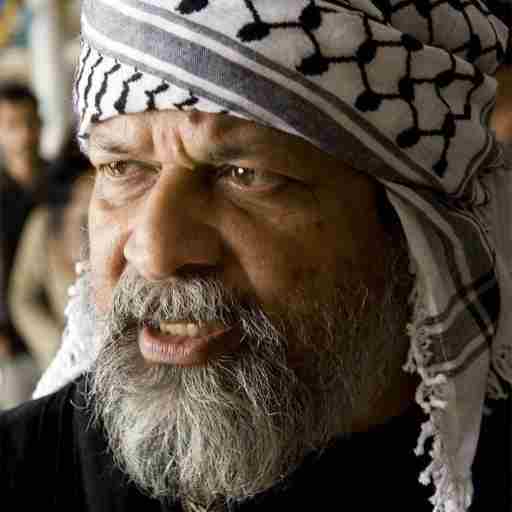
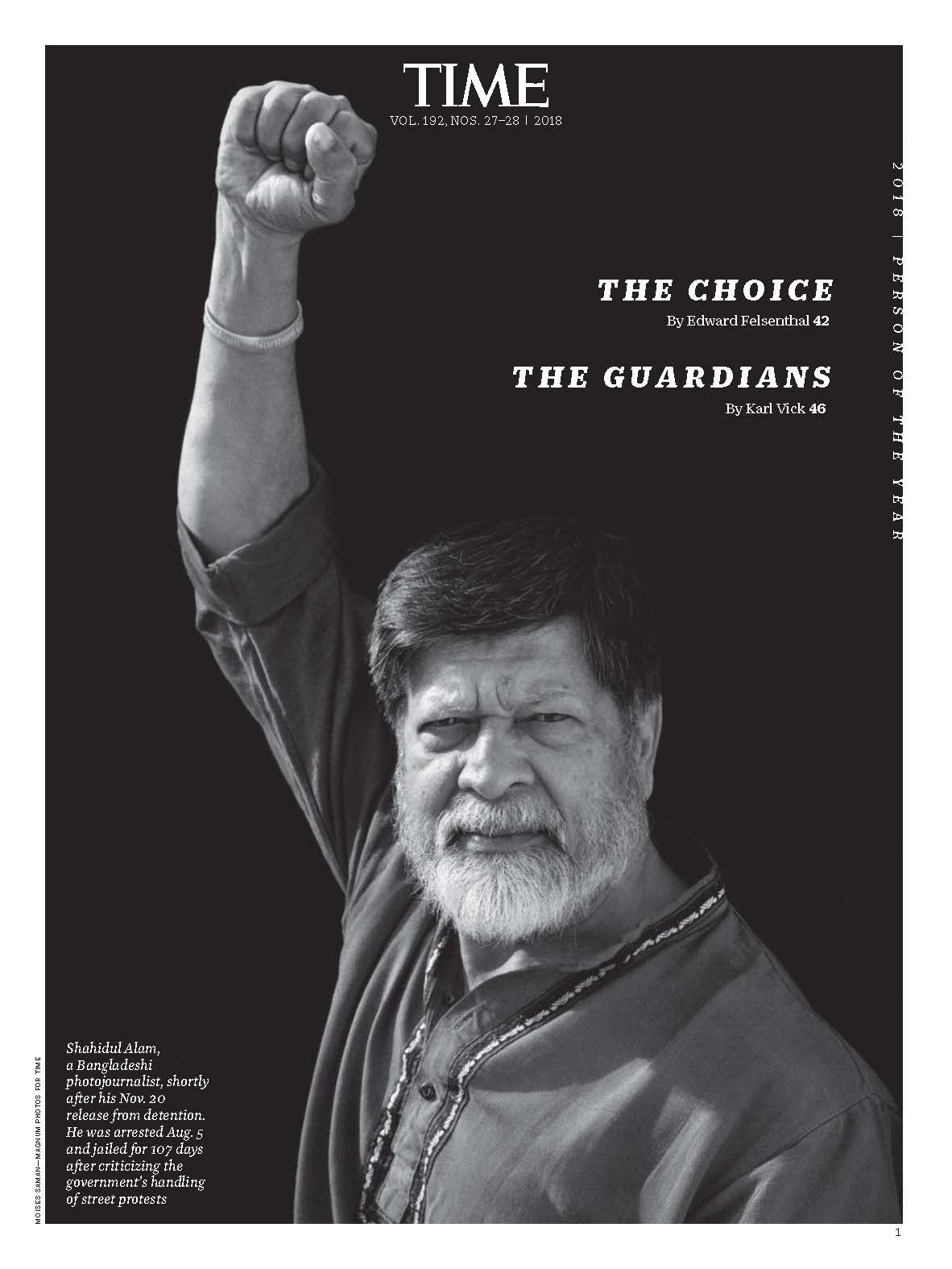
Person of the Year 2018
Fighting for the rights of the humanity
Recent Posts
-
These photographs will ensure fascism never returns
Writer Firoz Ahmed speaks at opening of photo exhibition “Witness to the Uprising” at Alliance Francaise Dhaka. Firoz speaks of the role of photographers in general and Jibon Ahmed in particular in being at the forefront of the resistance and providing the evidence that will prevent the return of Sheikh Hasina and Awami League in…
-
Bangladesh Sails for Gaza
I have stood on a deck headed towards Gaza. I know what that feels like — the sea ahead of you, and the knowledge, sitting heavy in your chest, that on the other side people are being killed while the world carefully arranges its indifference. The brutality of the genocide, the horror of forced starvation.…
-
Dhanmondi’s Quiet Revolution
A Polling Day That Defied the Night’s Dark Omens The phone had glowed through the darkness—message after message, each one a fresh wound. Ballot boxes violated before dawn. Money changing hands in shadowed corners. Fists and threats. The virus of manipulation seemed to have infected every political body, metastasizing without prejudice. By first light, the…
-
Chobi Mela Diaries
It’s an old piece, but this film by Jaheen Faruque Alam was produced during Chobi Mela X in 2019. The festival planning took place while I was in jail, with no certainty of whether or when I might come out. It is a sign of the resilience of the festival and the community that runs…
-
Lecture at COLMEX Mexico City
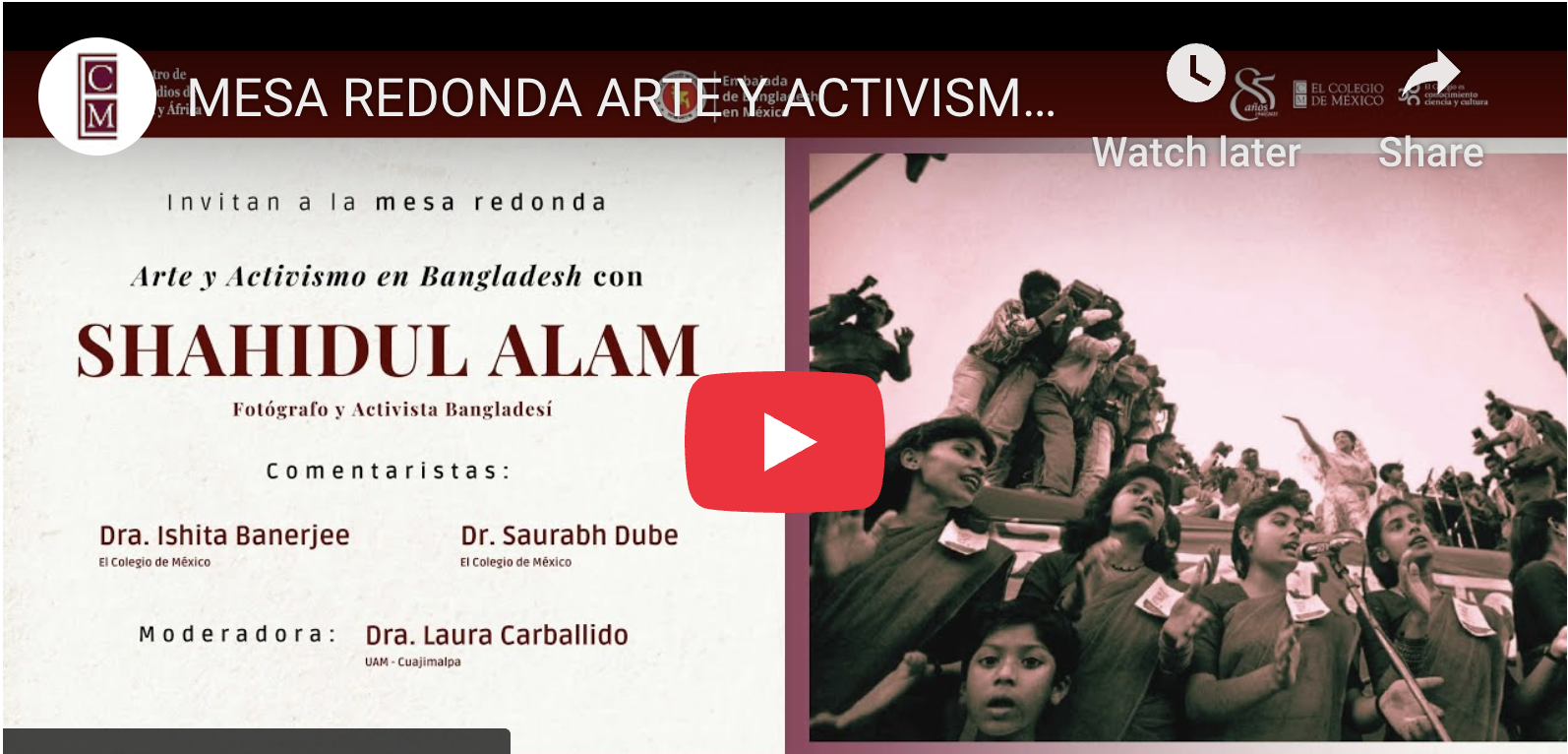
Center of Studies of Asia and Africa. Mexico City. The audience included academics, scholars and postgraduate students. Panelists included the professors, Saurabh Dube, Ishita Banerjee and Tithi Bhattacharya. Laura Carballido moderated. 29th August 2025 –
Browse by Categories
1971 Arts Bangladesh Capitalism Caretaker government Censorship China Chittagong Hill Tracts Chobi Mela VII Coal Colonialism Consortium government Corruption COVID 19 Crossfire culture Current News Photos Democracy development disasters Drik and its initiatives economy Education Elections Energy environment exploitation features Film Garments Gas Gender Genocide Global Issues Governance guimet Health Human rights Humour Immigration Imperialism India Interviews Islam Kalpana Chakma Killings Law lectures literature Major Features on Bangladesh Majority World media Media issues Migration Military mining Monarchy Music My Photo Essays New Age New Media News Archives Occupation Oil Pakistan Pathshala People Personal Photography Photojournalism Photojournalism issues politics Poverty RAB Rahnuma Ahmed Religion Resistance Reviews Science security Shahidul Alam Sheikh Hasina short stories South Asia Southern Exposure Sports Sri Lanka surveillance Taliban Technology Terrorism Transport UK Uncategorized USA Violence War war on terror Water World
Browse by Tags
1971 Afghanistan apartheid Art Arts award Bangladesh book censorship Children china Chittagong Hill Tracts Chobi Mela Chobi Mela VII CIA contest corruption culture Death democracy development Dhaka Drik Economy education Elections energy Environment exhibition exploitation Festival Film Freedom of Expression garments Gaza Genocide Governance Guardian health history Human rights India iran Iraq Islam Israel Journalism justice killing Law Learning literature London Majority World media Migration Military Munem Wasif music my journey as a witness Obama Occupation Pakistan Palestine Pathshala Photography Photojournalism poetry police politics Poverty propaganda protest RAB Rahnuma Ahmed Rana Plaza religion repression resistance Rights Shahbagh Shahidul Alam Sheikh Hasina Sri Lanka Tazreen Fashions teaching Technology Terrorism torture training travel UK USA Violence Visual Arts War War Crimes War of Liberation war on terror women
-
Posts
RECENT NEWS
-
Shahidul Alam News
Recent Posts Browse by Categories Browse by Tags
-
Conversations
Beyond a Witness – Photography and Social Justice || Sebastião Salgado & Shahidul Alam Keeping in line with the month’s theme ‘Art as Witness’, MAP in association with the Bangalore International Centre (BIC), brought together two exemplary photographers of social action and change, Sebastião Salgado and Shahidul Alam, in a webinar hosted on 27 June.…
-
Webinars
On the Edge of the Settled World Hosted by the project on Unsettlement, an initiative of the Committee on Global Thought Outreach Partners: Columbia School of the Arts; The Society of Fellows and Heyman Center for the Humanities Today, millions of people are stranded in states of permanent displacement. They live in places that lack infrastructures of permanence,…
-
About Me
Time Magazine Person of the Year 2018 and National Geographic Explorer at Large, photographer, writer and curator Shahidul Alam has championed human rights throughout his career. Recipient of the Shilpakala Award, the highest national award given to Bangladeshi artists, Alam obtained a PhD in chemistry before switching to photography. Returning to Dhaka in 1984, he…
-
News
-
DrikPath building
Top view from drone (South View) The building from Panthapath (South West View). Top view from Shelltech building (South East View)
-
Awards
CPJ is honored to present its 2020 International Press Freedom Award to Bangladeshi journalist Shahidul Alam. International Press Freedom Awards Alam is a renowned photojournalist and commenter, and the founder of the Bangladeshi multimedia training organization the Pathshala Media Institute and the Drik photo library. He also co-founded the photo agency Majority World and the Chobi Mela…
-
Interviews
Voice of America. On Bangladeshi Democracy After the publication of my new book “The Tide Will Turn” by Steidl With Soledad O’Brien: Matter of Fact Shahidul Alam on Al Jazeera Upfront with Mehdi Hasan BenarNews Exclusive interview with Bangladeshi photojournalist and activist, Shahidul Alam at RFA Studio, Washington DC. Hosted by Imran Vittachi. Interview…
-
Presentations
Bangladeshi activist and photographer Shahidul Alam spent over 100 days in prison in his native country for speaking out to the press about anti-government protests. Watch LIVE at the National Geographic Storytellers Summit as he joins writer Wajahat Ali in conversation about his imprisonment, the conversation it sparked about human rights, and the importance of…
-
Campus Protests
Student movement against campus: Selected writings from the Jahangirnagar University ’98 movement. The paper Documentation of an unprecedented movement that shook many corners. Held in 1998, the female students’ movement against rape and sexual harassment at Jahangirnagar University set some example that went across and beyond the national border. Soon after the turmoil was over,…
-
The Tide Will Turn
It’s Nice That Described by its editor Vijay Prashad as about “the beauty and tragedy of our world, about how to photograph that dialectic, and about how to write about it,” the book comprises four parts: a record of Alam’s time in jail; a chapter each on art and politics, exploring their inevitable interconnectedness; and…
-
General News III
Kathmandu International Art Fair Siddhartha Arts Foundation invites you to the gala opening of The Second Kathmandu International Art Festival Earth | Body | Mind Right Honorable Prime Minister of Nepal?Dr. Baburam Bhattarai has graciously consented to?inaugurate the festival.?Sunday, 25th November 2012Regal Ballroom, Yak & Yeti Hotel, Durbar Marg?11 AM sharp Wednesday the 28th November.…
-
Rahnuma Ahmed's updates on Moshrefa Mishu
Subscribe to ShahidulNews February 4 2011. 9:06 pm Dear friends, Yesterday evening I got an emergency text message from Sharmine who is Moshrefa Mishu’s youngest sister which said Mishu’s face had gone numb, her speech was slurred, she was having difficulty in talking. A junior doctor came in, examined her, said he thought it was…
-
Pathshala Updates X
Subscribe to ShahidulNews Saikat Majumder wins 2nd prize in Days Japan Stateless Rohingya Refugees of Burma A project proposal by Saiful Huq Omi ABOUT THIS PROJECT For decades, the xenophobic, Burmese military junta has refused to recognize the Rohingya as a distinct Muslim ethnic minority living in western Burma. Internationally, their story is underreported. The…
-
Contests, Exhibitions, Festivals and Conferences II
Subscribe to ShahidulNews DELHI PHOTO FESTIVAL http://www.delhiphotofestival.com Call for Submissions Inviting photographers, photo practitioners, curators,?organizations, institutions &?collectives to a)???Submit?bodies of work, projects, photo essays and stories for print exhibitions that interpret the festival theme of?Affinity. b)???Digital exhibitions, Slideshows, multimedia projects, films and photo-based installations to be shown during the festival at the evening screenings and…
-
Things friends have been upto II
Subscribe to ShahidulNews ART AS WITNESS Launch of book edited by Parthiv Shah and Sana Das The book will be released by Prof Ashis Nandy and Prashant Bhushan at a panel discussion Art to Politics: Frames of Freedom?on 8th December 2010 at 7.00 pm at Goethe-Institut/ Max Muller Bhavan, 3 Kasturba Gandhi Marg, New Delhi-110001…
-
Pathshala Update IX
Subscribe to ShahidulNews GMB Akash wins UNICEF award GMB Akash won Third Prize in the?UNICEF Photo of the Year Award for 2010 for his story?The Bitterest Pill. Rapid Action Battalion, accused of hundreds of extra-judicial killings, received training from UK officers, cables reveal By Fariha Karim and Ian Cobain guardian.co.uk, Tuesday 21 December 2010 21.30…
-
Humour
Subscribe to ShahidulNews Obama! A modern U.S. president. (musical spoof) From?Ron Butler comes this seriously funny music video where the President responds to those who say he’s not living up to the country’s expectations. Not only is it a pretty convincing argument (as well as an entertaining one) but Butler does a near-perfect impression of…
-
New Recruits
Subscribe to ShahidulNews Chulie de Silva Chobi Mela VI Secretariat ‘The Moving Finger writes; and, having writ, Moves on: nor all your Piety nor Wit Shall ?lure it back to cancel half a Line. …, said Chulie ?quoting from the Rubaiyat of Omar Khayyam to her colleagues at the World Bank, Sri Lanka last month.?…
-
General News II
Subscribe to ShahidulNews Lecture by Colin Gonzalves Colin had been very helpful in linking me up with the bonded labourers in the sugar cane plantations in Maharashtra. Shahidul. ====================================== I am pleased to attached herewith an invitation letter to a Public Lecture on Public Interest Litigation and Securing Economic and Social Rights by renowned Human…
-
Pathshala Updates VIII
Subscribe to ShahidulNews GMB Akash in Marie Claire Durga Puja By 1st Year Students Genocides in Bangladesh Saiful Huq Omi Sacrificing lives to Debi?Durga By Saikat Mojumder Netrakona Life Among the Broken Ships by Saiful Huq Omi The II International Festival of Photography MAN AND SEA 21.10-15.11.2010 Krasnodar – Novorossiysk. Russia Bjerkely Bjerkely Folkeh?yskole and…
-
Job Offers
Subscribe to ShahidulNews Current Opening at Drik ICT Title Web Developer Department Software Location Dhaka Job Description To design and develop corporate websites, web portal and e-commerce site ensuring strong functionality and optimization To design and develop relational database systems and their web interfaces. Create, manage, document, and maintain a library of scripts, code snippets,…
-
Pathshala Updates VII
Subscribe to ShahidulNews MI6 consulted David Miliband on interrogations Former foreign secretary was consulted before ‘difficult’ attempts to gather information from detainees in certain countries Ian Cobain in London and Fariha Karim in Dhaka guardian.co.uk, Tuesday 21 September 2010 22.10 BST David Miliband was consulted by MI6 prior to ‘any particularly difficult’ attempts to gain…
-
Drik Related News
Subscribe to ShahidulNews Violence and Representation Tate Modern? Starr Auditorium Saturday 18 September 2010,?10.30?17.00 To coincide with the exhibition Exposed: Voyeurism, Surveillance and the Camera, this symposium explores violence as a subject in relation to representations in the broadest range of historical and geographical contexts. It includes international artists, photojournalists and theorists who from their…
-
Breaking News II
Subscribe to ShahidulNews Earthquake in Dhaka 23:22 Sep 10 2010. Earthquake Details This event has been reviewed by a seismologist. Magnitude 4.8 Date-Time Friday, September 10, 2010 at 17:24:17 UTC Friday, September 10, 2010 at 11:24:17 PM at epicenter Time of Earthquake in other Time Zones Location 23.422?N, 90.695?E Depth 14.1 km (8.8 miles) Region…
-
Pathshala Updates VI
Wins and exhibitions for Khaled Hasan and Andrew Biraj The SOPA 2010 Awards for Editorial Excellence Excellence in Feature Photography Publication: Reuters Entry Title: Heading home Journalist: Andrew Biraj Comments: A courageous photo that cannot fail to move the reader. Implies so much. Extremely powerful and thought-provoking. Clean,?strong, striking. Exhibition at Promenades Photographique Khaled Hasan…
-
Workshops Courses, Conferences, Seminars, Webinars
Subscribe to ShahidulNews Free Online Workshop Sarah Harbutt was the director of photography of Newsweek and a fellow jury member of World Press Photo in 2003. Her passion for photography was contagious. EDITORIAL PHOTOGRAPHY?/?SARAH HARBUTT /?PATRICK WITTY This 10-week workshop aims at producing new stories based on participants’ ideas. The workshop will focus on both…
-
Events at Drik Gallery II
Subscribe to ShahidulNews Living in the Urban Jungle Photography Exhibition, Dhaka Drik Gallery, Dhanmondi 26 October ? 1 November 2010 3-8 pm, everyday Launching ceremony at 4pm on 25 October 2010 in Grand Ball Room of Sonargaon Hotel. Live streaming at: www.drik.tv/living-in-the-urban-jungle Earlier project: Do You See My World? Exhibition, Barisal Ashwini Kumar Hall, Sadar…
-
Pathshala Updates V
Spotlight: Focus on Bangladesh May 4, 2010 Since SDN’s launch in 2008, some of the strongest and most original work has come from Bangladesh. Much of this can be credited to Shahidul Alam, founder of the Drik Photo Agency and MajorityWorld.com, a website championing the cause of indigenous photographers from the developing world and the…
-
Crossfire
An Installation by Shahidul Alam on Extra Judicial Killings The Rapid Action Battalion (RAB) was set up on 26th March 2004 to curb corruption in Bangladesh. It consists of members of Bangladesh Police, Bangladesh Army, Bangladesh Navy and Bangladesh Air Force. RAB has increasingly been criticized for the extra judicial killings and torture that have…
-
Must See
The Video the US Army Doesn’t Want You to See
-
Pathshala Updates IV
Nurul Kabir receives death threat A man, who claimed to be ?Top Terror Mamun? on Tuesday threatened Nurul Kabir, editor of New Age, and his family of dire consequences if he would continue to write and speak against ?terrorism of various sorts.? The caller, who made the call from the number 01816904359 at 12:15pm, also…
-
Media Academy
Subscribe to ShahidulNews larger version for higher bandwidth smaller version for lower bandwidth Riz Khan to talk to Dhaka Audience through videoconference at Media Academy Launch Media Academy Launch on 18th May 2010 You are cordially invited to the opening ceremony of Pathshala South Asian Media Academy at?the Goethe-Institut Auditorium, Dhaka, on Tuesday, 18 May…
-
Chobi Mela VI Updates
Subscribe to ShahidulNews The first episode of the documentary “Chobi Mela? will be on air today at 6.00 pm on Channel I. Chobi Mela VI Blog By Chulie De Silva Chobi Mela VI Google Map By Bai Xi/Natalie Voting for Themes ends 11:59 GMT 15th February 2010 Vote for your favourite theme at: http://www.chobimela.org/ Just…
-
Pathshala Updates III
Harijan: The Sons of God “Untouchables” in Bangladesh Wahid Adnan featured in SocialDocumentary.net A young “untouchable” sweeper is performing as Krisna in Krishnaleela (affair between Krisna and Radha). Photo by Wahid Adnan.They pick up garbage, sweep the streets, clean the gutters, load and unload the garbage trucks. They are “achuta”, or untouchable; members of a…
-
Interesting Videos
Stop motion animation with Wolf and Pig by: Vic Mu?iz posted by Patricia Algarabel
-
Drik Updates
Subscribe to ShahidulNews Celebrity visitors to Drik November has been a very interesting month. Social entrepreneurs from all over the world converged at Drik in the first week. Visitors included representatives from Google, and Rolls Royce as well as philanthropists and experts on social business. The Prime Minister came to a Drik event at Sheraton…
-
Bangladesh Oil and Gas
Clip 1 of a series of interviews in Bangla of Professor Anu Muhammad by Shahidul Alam, relating to the debate surrounding the utilisation of Bangladesh’s oil and gas resources. Professor Muhammad and other activists have been questioning the policy of the Bangladesh Government on its use of oil and gas. On the 2nd September 2009,…
-
Books
Crescent and Delta?(published Oct 2008) The Bangladesh Story by David Urch Edited by John Clarke Proceeds of the sale go to the University of Buckingham?Bangladesh Scholarship In 2007 the media gave comprehensive coverage to India?and Pakistan on the 60th anniversary of independence.? Nothing?was said about East Pakistan, now Bangladesh. Crescent and Delta redresses this injustice.…
-
Subscribe and Unsubscribe
shahidulnews — About shahidulnews English (USA) To see the collection of prior postings to the list, visit the?shahidulnews Archives. Using shahidulnews To post a message to all the list members, send email to?shahidulnews@drik-amsterdam-01.drik.net.You can subscribe to the list, or change your existing subscription, in the sections below. Subscribing to shahidulnews Subscribe to shahidulnews by filling…
-
Drik ICT
Webstreaming of Conference on Genocide, Truth and Justice The?Liberation?War?Museum?has organized the Second International Conference on Genocide, Truth and Justice, which will be held at the CIRDAP Auditorium,?Dhaka,?Bangladesh?on July 30 and 31, 2009. This conference has been organized at a time when?Bangladesh?is actively pursuing the trial of the perpetrators of murder, rape and arson during the…
-
Bangladesh Related Events Worldwide
Bangladeshi girl Purna Shiropa wins Judges Award for Excellence “Real Teens” Festival, New York. Attention to Purna Shiropa Children Film Director Bangladesh Dear Shiropa, The judges met this past weekend and your documentary?Our Boat is Our Address has been awarded the Judges Award for excellence. Congratulations!!! It will be pleasure to give Shiropa her award…
-
Webcasts
Online Symposium: Seeking Justice – Social Activism through Journalism & Documentary Practice The Centre for Documentary Practice invites you to logon and join the world?s first online journalism and documentary conference on October 15th 2009, starting 12:01am (GMT). Speakers include Paul Fusco, Ed Kashi, Jodi Bieber, Marcus Bleasdale, Shahidul Alam, Gary Knight, Robin Hammond, Adam…
-
The unfolding crisis in Pakistan
THE UNFOLDING CRISIS IN PAKISTAN – I `The greatest threat lies in the tribal regions of Pakistan’ rahnuma ahmed We need more troops, more helicopters, more satellites, more Predator drones in the Afghan border region. And we must make it clear that if Pakistan cannot or will not act, we will take out high-level terrorist…
-
Picture of the week II
Subscribe to ShahidulNews Police arrested 71 students of Dhaka College from the college dormitories and surrounding messes, in an overnight raid on Tuesday following clashes over dominance at a residential hall, between rival student activists of Bangladesh Chhatra League (BCL). A number of bullets, machetes and clubs were recovered during the raid. Dhaka, Bangladesh. March…
-
Pathshala Updates II
G M B Akash wins ??Travel photographer of the year? Student from the first batch of Pathshala G M B Akash wins ??Travel photographer of the year? award from Travel Photographer of the Year international (TPOY) photography contest 2009. UK JUDGES’ VERDICT Our congratulations go to the Travel Photographer of the Year 2009, GMB Akash,…
-
Grants, Fellowships, Residencies, Scholarships etc., archives
Subscribe to ShahidulNews Before submitting to a contest, you would do well to follow the advice in the blog Vignettes by Dennis Rito. ———————————– Commonwealth Foundation Residencies Call for entries Apply online Deadline 31 March 2010 Visual artists from Commonwealth countries are invited to apply for the 2010 Commonwealth Connections residency programme. Six winning applicants…
-
BDR Rebellion updates
Inquiry into custodial deaths of BDR men demanded New Age Rights activists, civil society members and political alliance on Saturday demanded independent inquiry into the custodial deaths of the Bangladesh Rifles members. They also demanded trial of the BDR rebels in civilian court under general criminal laws instead of the Army Act to ensure a…
-
CMV Phase II
NECROPOLIS Two men meet on the street. They have to make a deal. Or rather they want to make a deal. One has something to sell and the other needs something to buy. The Dealer is unsure what to peddle or whether he wants to peddle anything in the first place. The Client knows what…
-
CMV Exhibits VII
WINDOWS-2001, (from DOWN THE ROAD OF LIFE series? Masaki Hirano East Timor East Timor finally became an independent country in the 21st century, after being colonised by the Portuguese for hundreds of years, occupied by the Japanese army during World War 2, and annexed to Indonesia from 1975. When the independence of East Timor was…
-
CMV Exhibits VI
Tibetan Unrest Mads Nissen Denmark On March 10, 2008, a series of demonstrations began in Lhasa to mark the 49th anniversary of an unsuccessful Tibetan uprising against Chinese rule in 1959. The protests began peacefully but escalated into Tibet’s most violent unrest in nearly two decades. Police battled against angry Tibetan protestors, vehicles were overturned,…
-
About
This is a blog maintained by Bangladeshi photographer and writer Shahidul Alam. It is open to anyone who might like to contribute, but content is moderated for style, content and relevance. Please only send work where you own the copyright. Subscribe to ShahidulNews: About Shahidul Alam: Drik Media Academy Chobi Mela: International Festival of Photography
-
CMV Press
Press conference at Drik Gallery II on 10th January 2009 [wpvideo Bup4B5VE] photo_feature on Forum Magazine Feature in SomewhereinDhaka.net
-
CMV Exhibits V
The Eye of the Beholder?? Dhanushkha Amarasekara Sri Lanka ?A tree that can fill the span Of a man?s arms Grows from a downy tip; A terrace nine stories high Rises from handfuls of earth; A journey of a thousand miles Starts from beneath one?s feet.? – Lao Tzu This body of work is a…
-
CMV Exhibits IV
National Geographic All Roads Photography Program Group Show Afghanistan, Argentina, Azerbaijan, Bangladesh The National Geographic All Roads Film Project recognizes and supports talented indigenous and underrepresented minority-culture photographers from around the globe who are documenting their changing worlds. The program provides a forum for photographers to showcase their work to a global audience through festivals,…
-
Drik India Updates
Subscribe to ShahidulNews Abir Abdullah Presents at Drik India on 4th September 2010, Drik’s 21st Anniversary ?Mahasweta Devi Close-up? Best Short Documentary 3rd International Documentary & Short Film Festival of Kerala (2010) Three years ago, a team of a few professionals from Drik India, started off with a PD 170 camera following the legendary writer…
-
CMV Exhibits III
Artist in Exile ? M. F. Husain Parthiv Shah India M F Husain, born on September 17, 1915, in Pandharpur, Maharashtra, is one of India’s best known artists. According to Forbes magazine, he has been called the “Picasso of India”. In the 1990s, some of Husain’s works became controversial because of their portrayal of Hindu…
-
CMV Exhibits II
Diamond Matters Kadir van Lohuizen / NOOR Netherlands In the 1990s I did a number of photo-reportages during the fighting in Zaire (present-day Democratic Republic of Congo), Sierra Leone and Angola, conflicts which were often dismissed as tribal wars, the final convulsions of the Cold War. By degrees, however, they increasingly became conflicts over raw…
-
Maps
Click for larger view of map Click for route from Drik to Pathshala
-
Pathshala Updates
Pathshala, the Tree of Knowledge Apart from my long friendship with Shahidul who had invited me to be??the first teacher? at the Pathshala photography institute, I admired the name he had given it. Pathshala evokes the idea of a school set under a tree in the common imagination. However, in the East as we know…
-
CMV Exhibits I
Leprosy in China Kosuke Okahara Japan Though leprosy is an old disease that is 100% curable by medicines, there are over 600 leprosy villages in southern provinces of China housing over 40,000 ex-leprosy patients. In the villages, there are people who are disabled but they are not patients of leprosy anymore. When multi-drug therapy came…
-
Southern Exposure
Subscribe to ShahidulNews Women at work Smita Barooah Sanyal 8 March 2010 marks the centenary year of International Woman?s Day. Women perform 66 per cent of the world?s work, produce 50 per cent of the food, but earn 10 per cent of the income and own 1 per cent of the property. My photographic journey…
-
Drik Videos
Subscribe to ShahidulNews Bhaber tala by Anushe Shafi Mondol and Nozrul perform at British Council Anushe, Shofi Mondol and Nozrul in a spontaneous performance at the British Council What Happens in Police Remand? Bangla interview of Anis Raihan by Shahidul Alam An interview of journalist Anis Raihan who was a student when he was arrested…
-
Things friends have been up to
Subscribe to ShahidulNews Modern-Dance History Times Five, With Plenty of Theatricality Julieta Cervantes for The New York Times ? NEWARK ? It?s slightly astonishing that ?Fly: Five First Ladies of Dance? hasn?t had a longer season in the New York precincts since its premiere at the Kumble Theater in Brooklyn in May of last year.…
-
Internships
New Interns from China Natalie and Jojo have just arrived from Shantou University in China. They will be with us for 80 days. They are staying with Jessica. Jojo Natalie Natalie and Jojo at the Red Tomato pictures supplied by Jeevani. ———————————– THE MAY 18 MEMORIAL FOUNDATION 2009 INTERNATIONAL INTERNSHIP PROGRAM Closing date: 28th November…
-
Events at Drik Gallery
?Rhythmic Wing Beats? ?Pakhai Pakhai Chondo? Dr. Niaz Rahman?s Solo Photography Exhibition on BIRDS PRESS RELEASE from Drik Gallery Dr. Niaz Rahman an eye specialist, a photographer and nature lover with a passion for bird photography, presents a colourful selection of his photographs taken over the last two decades from different corners of Bangladesh and…
-
Breaking News
Subscribe to ShahidulNews Facebook blocked in Bangladesh Facebook blocked by Rapid Action Battalion (RAB) in Bangladesh Dhaka, May 29 (bdnews24.com) ? Facebook has been blocked in Bangladesh for a brief period, a senior BTRC official told bdnews24.com Saturday evening after hundreds of users reported the social networking site was down. The official, speaking on condition…
-
Majority World Updates
Subscribe to ShahidulNews Poised for lift off Major Dutch foundation backs unique social purpose photo library ? Majority World CIC is a niche picture agency that promotes the work of talented local photographers from Africa, Asia, Latin America and the Middle East (the majority world). Its mission is to? provide them with? a fair chance…
-
CMV Updates
CMV opens in Kathmandu today (22nd May 2009). Watch it live at: http://www.photocircle.com.np/chobimela/live.html ? ? Impressive banners in the streets And then the rains Plan B: escape to the gallery Inside the gallery click to see 360 degree view of gallery (needs flash) ??? Chobi Mela V catalogue PDF now available cm-v_catalogue ? ? ?…
-
Job Offer Archives
Subscribe to ShahidulNews HR Manager at Drik Human Resource Manager: A dynamic person to be in charge of all HR functions of the entire organization along with its branches and initiatives including recruitment, assist the authority in establishing, developing, implementing and maintaining the management system of the company, ensure job analysis, description and determine competency…
-
Picture of the Week
In recent findings by ICDDRB across 85% children within the age of 6 to 11months in Bangladesh are suffering from anaemia. Among teenage girls and pregnant women this rate is as high as 40 to 46%. According to experts anaemia in children causes retardation or slow intellectual growth, diminishes resistance, and aggravates breathing, kidney and…
-
News Archives
Earthquake scare not substantiated I have no way of verifying this, but here is an interesting PDF sent by Kishor Pradhan. The eclipse quake theory is as follows, When the gravitational force of the sun and moon are both pulling on a plate that has not had series of recent earth quakes, the extra pull…
-
Grants Fellowships Residencies Scholarships
Subscribe to ShahidulNews Go on assignment to Arnhem Land, Australia to make a documentary for Nat Geo Aventure. Hello, I would like to let you know about an exciting scholarship opportunity for your students. WorldNomads.com in conjunction with Nat Geo Adventure and World Expeditions are offering one talented individual the chance to be mentored by…
-
Calendar 2008
When Pathshala started, I can remember Dhaka’s photography circles reacted by forming two camps. One was thrilled at the prospect of ‘real’ photography education starting in Bangladesh for the very first time, and the other remained strongly sceptical about what Shahidul Alam was getting up to next. Pathshala’s first students came from the former camp,…
-
General News
Tushikur Rahman – Finalist for Emerging Photographer Grant 2011 Fatalistic Tendency play this essay on burn magazine There is a place in which your privacy, intimacy, integrity and inviolability are guaranteed. Your own body and mind, that unique temple and a familiar territory of sense and personal history. Anxiety and stress can cause sleep deprivation,…
-
Contests and Grants archive
Asia-Pacific Photograph Contest The International Labor Organization, Disabled People’s International, and Irish Aid are sponsoring a photo contest for photographers in all Asian and Pacific countries. The theme of the contest is “Decent work for persons with disabilities.” Entry deadline: November 21. Entries must be digital photos of disabled people either in the work environment…
-
Workshops, Courses and Conferences Archives
INTERNATIONAL PHOTOGRAPHY WORKSHOP T?rrega (Lleida) October 16-18, 2008 CLOSING DATE SEPTEMBER 15 RECYCLING PHOTOGRAPHS Archives, samplings, postcards, found photographs Lynne Cohen and Joachim Schmid Directed by Joan Fontcuberta Language of workshop: English Participants will produce work related to some part of the city on which documentation will have been gathered beforehand. These materials may include…
-
Contests, Exhibitions, Conferences and Festivals
Before submitting to a contest, you would do well to follow the advice in the blog Vignettes by Dennis Rito —————————————————————————————– UNFCCC CDM International Photo and Video Contest 2010 Two weeks to go There are only two weeks to go in the UNFCCC/CDM International Photo and Video Contest 2010. The contest is a great way…
-
Profile
As a journalist, your only space is at the edge. You have to be constantly feeling the heat. Go back one more step, and you may cease to be effective. There are no safe options, and no prizes for popularity and if you’re not making certain people uncomfortable by your presence, you are probably doing…